

You’re doing better than ever. More customers. More revenue. More proof that this thing you built actually works.
So why does it feel heavier than it did a year ago?
Most business owners assume the answer is simple: there’s just more to do. More often, that’s only half the story.
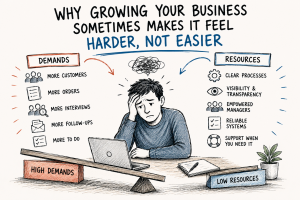
It’s not the demands. It’s the gap.
In 2001, organizational psychologists Evangelia Demerouti and Arnold Bakker published research in the Journal of Applied Psychology introducing what’s now known as the Job Demands-Resources (JD-R) model.1 Their research sorted every working condition into two buckets: demands (the things a job requires of you) and resources (the support available to help you meet those demands).
The finding that mattered most: demands and resources don’t hurt you the same way. High demands mainly drive exhaustion. But it’s a lack of resources that drives disengagement — the sense of pulling back, going through the motions, losing your grip on work that used to energize you.1
Bakker and Demerouti have kept building on this model for over two decades since, and one theme holds steady across the research: job resources don’t just help in general — they specifically buffer the impact of high demands on burnout.2 More demands aren’t automatically a problem. Demands without the resources to match them are.
What this looks like in a growing business
Translate that into hiring, and the picture gets familiar fast.
Every new customer is a demand. Every open role is a demand. Every candidate in your pipeline, every interview to schedule, every offer to draft — all demands. None of that is unusual. It’s what growth looks like.
The strain shows up when those demands keep multiplying while your resources — your systems, your processes, the support carrying some of that weight — stay exactly where they were when your team was half this size.
That gap is what the research is actually describing. Not too much work. Too little structure to carry it.
Why “just work harder” was never going to fix this
This is where a lot of business owners get stuck trying to solve a resource problem with more effort. Working later. Checking in more often. Personally reviewing every resume because you’re not sure anyone else will catch what you’d catch.
But the JD-R research points somewhere else entirely. Bakker and Demerouti’s more recent work, including their 2023 review in the Annual Review of Organizational Psychology and Organizational Behavior, keeps circling back to the same conclusion: sustainable performance comes from adding resources, not from absorbing more demand personally.2
In plain terms — you can’t outwork a structural gap. You can only close it.
What “more resources” actually looks like for hiring
A resource, in JD-R terms, isn’t necessarily more headcount or more budget. It’s anything that helps you meet a demand without it landing entirely on you. A clear process is a resource. Visibility your managers can act on without waiting for you is a resource. A system that tracks every candidate so nothing depends on your memory is a resource.
Picture what changes when those resources exist: a candidate applies, and the process moves without you personally pushing it forward. Your managers know what’s expected of them, because it’s visible — not because you told them again this morning. An interview doesn’t get delayed because one person got busy, because the process itself keeps things moving.
Growth stops costing you more of yourself, because the business finally has something in place to carry part of the load.
This is exactly the gap GateKeeper was built to close
GateKeeper exists to give your business the resource side of that equation. It’s a shared hiring system — a place where every open role, every candidate, and every next step lives somewhere your whole team can see, instead of somewhere only you can remember.
You still make the calls that matter. You’re still leading. You just stop being the resource your entire hiring process runs on.
Growth was supposed to feel like progress
The demands aren’t going away — that’s what a growing business looks like. What can change is whether your systems are carrying their share of that weight, or whether it’s all still landing on you. GateKeeper is free for teams up to five users. No credit card, no trial, no catch.
Claim Your Free GateKeeper Account →
Sources:
1. Demerouti, E., Bakker, A.B., Nachreiner, F. & Schaufeli, W.B. (2001). “The Job Demands-Resources Model of Burnout.” Journal of Applied Psychology, 86, 499–512. Eindhoven University of Technology.
2. Bakker, A.B., Demerouti, E. & Sanz-Vergel, A. (2023). “Job Demands–Resources Theory: Ten Years Later.” Annual Review of Organizational Psychology and Organizational Behavior. Annual Reviews.