
You close the laptop. Dinner’s on the table. Your kid is telling you about their day.
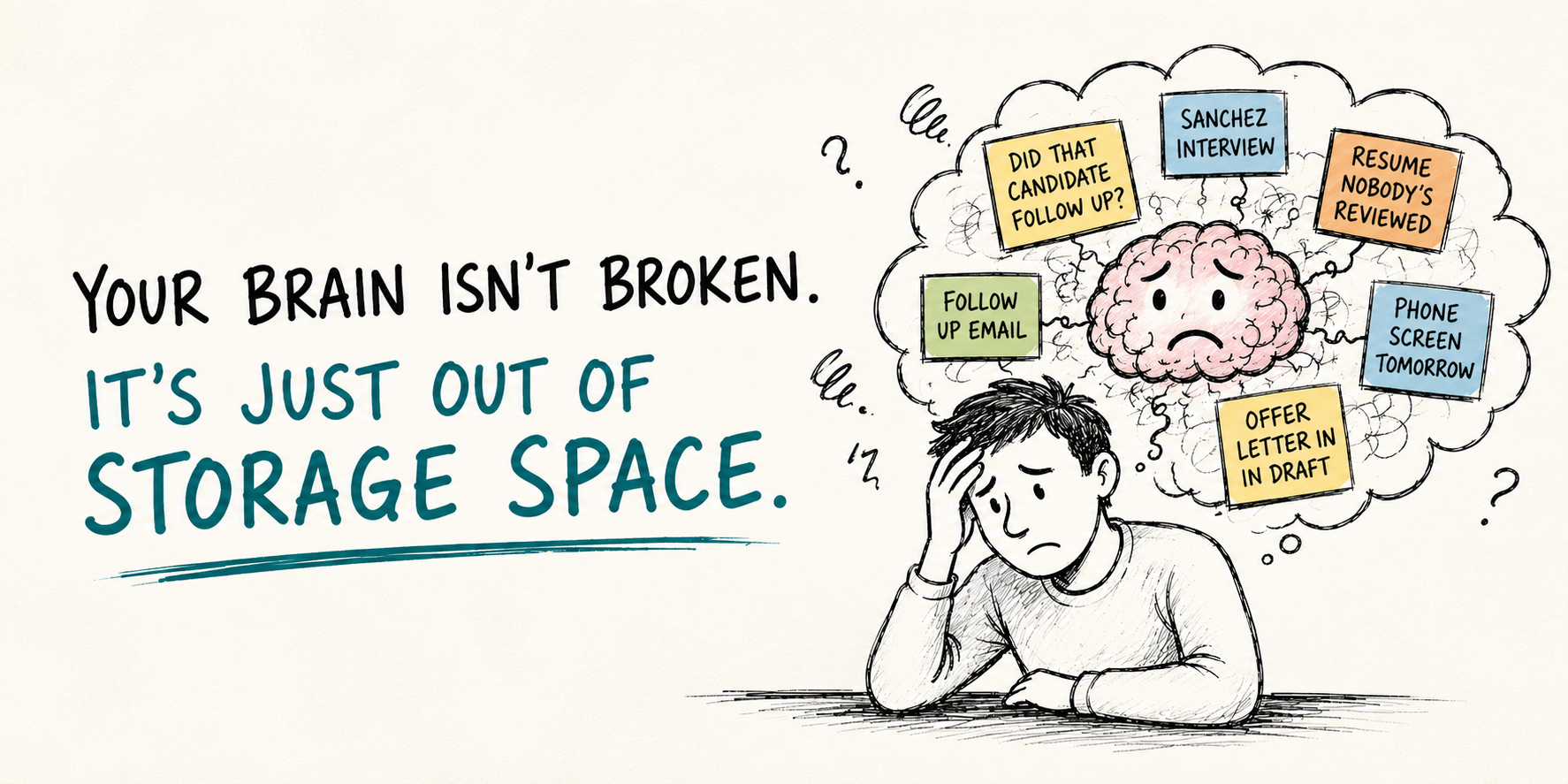
And somewhere in the back of your mind, a little voice is asking: did that candidate ever follow up?
You’re not distracted on purpose. You’re not a bad listener. Something else is going on — and it has a name.
It’s not your to-do list. It’s your working memory.
Psychologist John Sweller spent decades studying how the brain handles information, and his research on cognitive load pointed to something every overwhelmed manager already feels in their gut: working memory has a hard limit.1 It’s not a metaphor. It’s a bottleneck.
Long-term memory can store an almost unlimited amount of information. Working memory — the part of your brain doing the thinking right now — can only hold a handful of things at once before it starts to buckle.1
So what happens when your brain is trying to hold “the Sanchez interview,” “the follow-up you forgot,” “the resume nobody’s reviewed,” and “the offer letter that’s still sitting in draft” — all at the same time, on top of actually running your business?
It buckles. Quietly. Every day.
The tasks you haven’t finished are the loudest ones in your head
Here’s the part that surprises most business owners: it’s not the big decisions that wear you down the most. It’s the small, unfinished ones.
Back in the 1920s, psychologist Bluma Zeigarnik noticed that waiters could recall an unpaid tab in perfect detail — right up until the bill was settled. Then it vanished from memory almost instantly. Interrupted, unfinished tasks stuck around in the mind. Completed ones didn’t.2
Researchers have kept building on that finding ever since. In a 2011 study published in the Journal of Experimental Social Psychology, E.J. Masicampo and Roy Baumeister found that unfinished goals kept intruding on people’s thoughts during completely unrelated tasks — and hurt their performance on them.3 The unfinished hiring task doesn’t wait politely in a folder. It shows up while you’re trying to focus on something else entirely.
And it doesn’t just cost you focus during the day. A 2017 study published in the Journal of Occupational Health Psychology tracked 59 employees over 12 weeks and found that work left unfinished at the end of the week led to worse sleep — driven by rumination that kept the nervous system activated well past quitting time.4 The more that stacked up, the worse it got.
That’s the tax you’re paying every time a hiring step is left dangling. Not because you’re careless. Because your brain is doing exactly what brains do with open loops — it keeps circling back.
Why “just stay more organized” doesn’t fix it
Most business owners try to solve this the same way: try harder to remember. Keep better mental notes. Check your email one more time before bed, just to be sure.
But that approach fights biology, not laziness. The research doesn’t say you need a better memory. It says the fix is giving your brain fewer things it has to hold onto in the first place.
Interestingly, Masicampo and Baumeister’s research found something encouraging: intrusive thoughts about an unfinished task dropped once people made a concrete plan for finishing it — even before the task was actually done.3 Your brain doesn’t need everything wrapped up. It just needs to know the loop is being tracked somewhere it trusts.
That’s a system problem, not a willpower problem. And it’s the same conclusion workplace efficiency research keeps landing on: scattered tracking across sticky notes, spreadsheets, and inboxes is what quietly drains a manager’s focus, hour after hour, week after week.
What it looks like when hiring stops living in your head
Picture opening your laptop and knowing — instantly — exactly where every open role stands. Not because you checked. Because the system already shows you.
Your managers know what’s expected of them without waiting on you. Candidates don’t quietly disappear because a follow-up got lost in an inbox. And when you close the laptop at night, there’s nothing left circling — because every open loop has a home outside your head.
That’s not a productivity hack. That’s what happens when your hiring process finally has somewhere to live besides your working memory.
That’s exactly the gap GateKeeper was built to close. It gives your hiring process a single, shared place to track every candidate, every next step, and every follow-up — so your team can see what’s happening without you having to hold it all in your head, and without you having to check in on everyone just to feel like nothing’s slipping.
You still make the decisions that matter. You just stop being the whole hiring system by yourself.
Give your brain its working memory back
You don’t need to remember more. You need your business to depend a little less on your memory. GateKeeper is free for teams up to five users — no credit card, no trial clock ticking down, no catch.
Claim Your Free GateKeeper Account →
Sources:
1. Sweller, J. “Cognitive Load Theory.” ResearchGate.
2. Ovsiankina, M. & Zeigarnik, B. — as discussed in “The psychology of unfinished tasks,” Ness Labs.
3. Masicampo, E.J. & Baumeister, R.F. (2011). Journal of Experimental Social Psychology.
4. Syrek, C. et al. (2017). Journal of Occupational Health Psychology.