
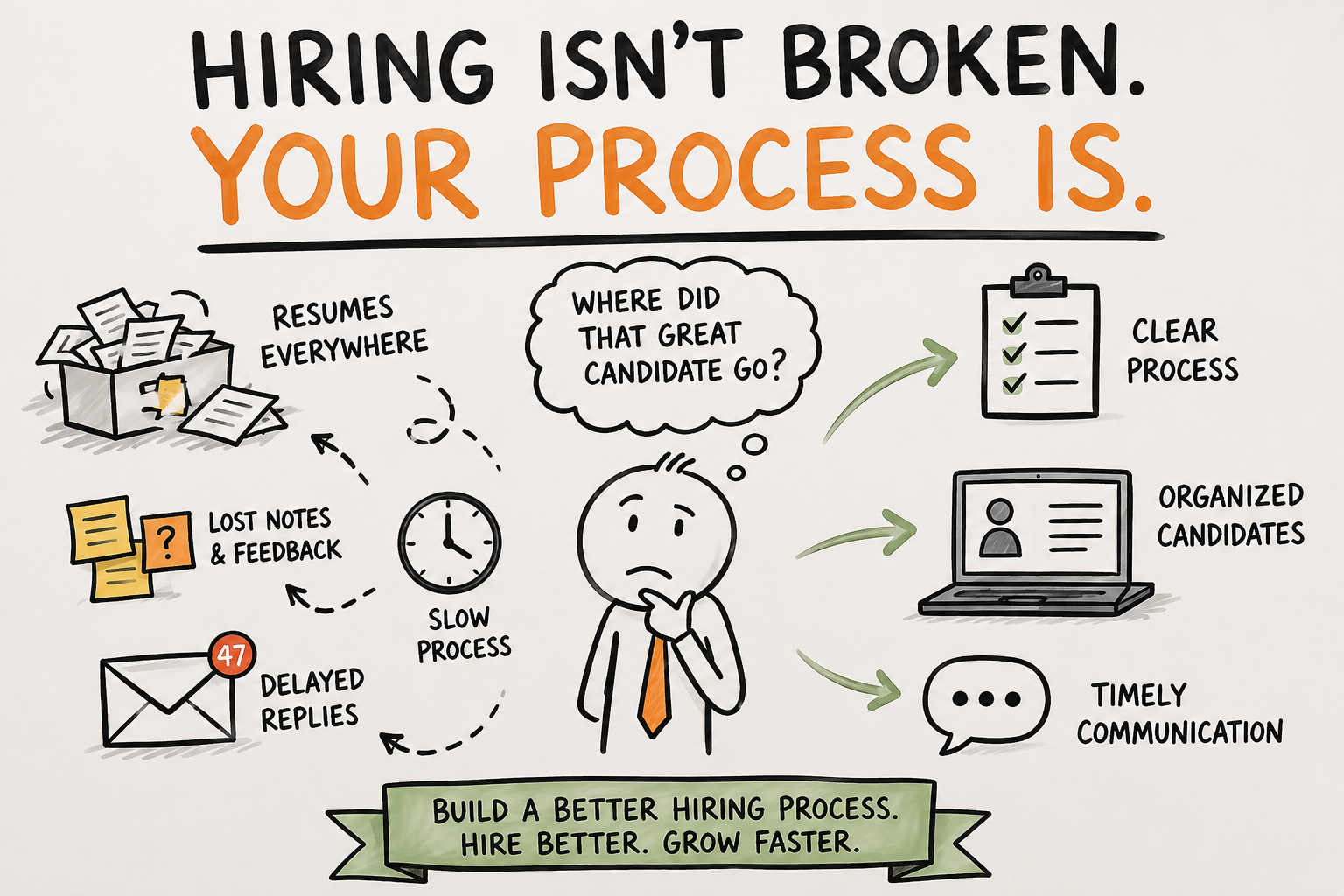
TL;DR: If hiring feels harder than ever, the problem probably isn’t your talent pool. It’s your process. Most small businesses don’t lose great candidates because too few people apply. They lose them because resumes get buried, feedback gets scattered across five places, and communication stalls out. The fix isn’t a bigger budget or a better job market. It’s a system you can run without keeping it all in your head.
Why Does Hiring Feel So Hard Right Now?
Maybe you’ve said one of these lately:
- “Nobody wants to work anymore.”
- “We can’t find qualified people.”
- “Hiring takes forever.”
- “Every great candidate disappears.”
You’re not alone. But here’s a question most business owners never stop to ask:
What if hiring isn’t actually the problem?
Picture two companies in the same city, hiring for the same role, offering similar pay and similar benefits. They’re pulling from the exact same pool of candidates.
One fills the position in two weeks.
The other spends three months rescheduling interviews, misplacing resumes, and wondering why nobody accepts the offer.
The difference isn’t talent. It’s the process.
Meet Hiring Debt
There’s a concept in software engineering called “technical debt.” A programmer named Ward Cunningham coined the term back in 1992 to describe what happens when a team ships code fast, using shortcuts instead of doing things right the first time. The code works fine, for a while. But every shortcut quietly adds interest. Eventually, the team spends more time fighting old shortcuts than building anything new.
Hiring runs on the exact same math.
It starts small:
- “I’ll remember what we talked about.”
- “Just email me the resume.”
- “We’ll get organized after this hire.”
- “The interview notes are around here somewhere.”
- “Let’s wait a few days before responding.”
None of these feel like a big deal in the moment. Until:
- A great candidate takes another offer.
- An interview gets forgotten entirely.
- Nobody can find the latest resume.
- Two managers ask the same candidate the same questions.
- The whole process stalls because one person is out sick.
That’s hiring debt. And just like any debt, the longer it goes unpaid, the more it costs you.
7 Signs Your Business Is Carrying Hiring Debt
1. Hiring Lives in Somebody’s Inbox
If resumes are buried in Gmail or Outlook, your process depends on search bars and memory instead of a system.
2. Interview Notes Live Everywhere
Sticky notes. Notebooks. A stray Google Doc. When feedback is scattered across five places, decisions get harder than they need to be.
3. Candidates Wait Days for a Reply
Every day of silence is a day a candidate can lose interest, or simply take another offer.
4. Every Manager Interviews Differently
Without a shared structure, every interview ends up measuring something different, which makes candidates hard to compare fairly.
5. Nobody Knows Where Things Stand
If “where are we with that candidate?” gets asked daily, your process is missing visibility.
6. Hiring Stops When One Person Is Out
A real process survives vacations, sick days, and busy weeks. If it doesn’t, it isn’t really a process. It’s one person’s memory.
7. You Keep Solving the Same Problems
If every hiring cycle feels like starting from scratch, you’re not building on what worked last time. You’re just repeating it.
What Hiring Debt Actually Costs You
None of this shows up on an invoice. But it’s real money.
Recent recruiting research puts the average cost per hire at roughly $851, and that number only counts hires that actually happen. Every candidate who drops out partway through means that money is already spent, with nothing to show for it.
And drop-off is common. In one 2025 industry survey, 42% of candidates said they walked away from a hiring process because scheduling an interview took too long. In Monster’s 2024 Work Watch Report, 47% of candidates named poor communication from the employer as their top reason for quitting the process altogether. Meanwhile, time-to-hire industry-wide keeps climbing: SHRM’s 2025 benchmarking data shows it’s stretched from about 33 days in 2021 to roughly 41 days today.
Slower processes. More silence. More candidates walking away before you ever get to make an offer. That’s hiring debt, compounding in real time.
Paying Down Hiring Debt
Here’s the good news: unlike financial debt, hiring debt doesn’t have to be paid off slowly. You can clear it in one move, by building a process that doesn’t depend on memory.
That starts with consistency, not necessarily new tools:
- One place where resumes and candidate info live
- A shared, repeatable set of interview questions
- Clear ownership of what happens next for every candidate
- Fast, predictable communication back to applicants
- A process that keeps moving even when one person is out
Software can’t create that consistency for you. But it can make it a lot easier to hold onto, especially once you’re hiring often enough that spreadsheets and inboxes stop keeping up.
If you’re deciding whether an applicant tracking system fits your business, our guide on Which Applicant Tracking System Makes Sense for Small Businesses? walks through it. New to the concept entirely? Start with What Is an Applicant Tracking System (ATS)?
How This Scales as You Grow
As a business grows, hiring gets more frequent, and hiring debt gets more expensive to carry. What worked when you hired three people often breaks by the time you’re hiring thirty.
That’s why growing companies document their process early: standardized interview questions, organized candidate communication, and a system anyone on the team can step into.
Building your first real hiring process? Read How to Use an ATS to Hire Your First 10 Employees. Feels like your current process is already held together with tape? From Chaos to Clarity: How to Audit Your Hiring Process in 30 Days will help you find exactly where it’s breaking.
One Question Worth Asking Yourself
Imagine you took next week off, with no notice.
Would someone else know exactly where every candidate stands? Who’s been interviewed. Who still needs feedback. Who’s waiting on an offer.
If the answer is no, here’s the honest truth:
You don’t have a hiring process. You have hiring memory.
Start Paying Down Your Hiring Debt Today
You don’t need to overhaul everything overnight. You need one place where hiring actually lives, instead of your inbox, your notes app, and your memory.
That’s exactly what GateKeeper was built for.
Sources: Ward Cunningham, “The WyCash Portfolio Management System,” OOPSLA 1992; Appcast 2025 Recruiting Benchmarks; Monster 2024 Work Watch Report; SHRM 2025 Talent Trends Report.

One Comment