
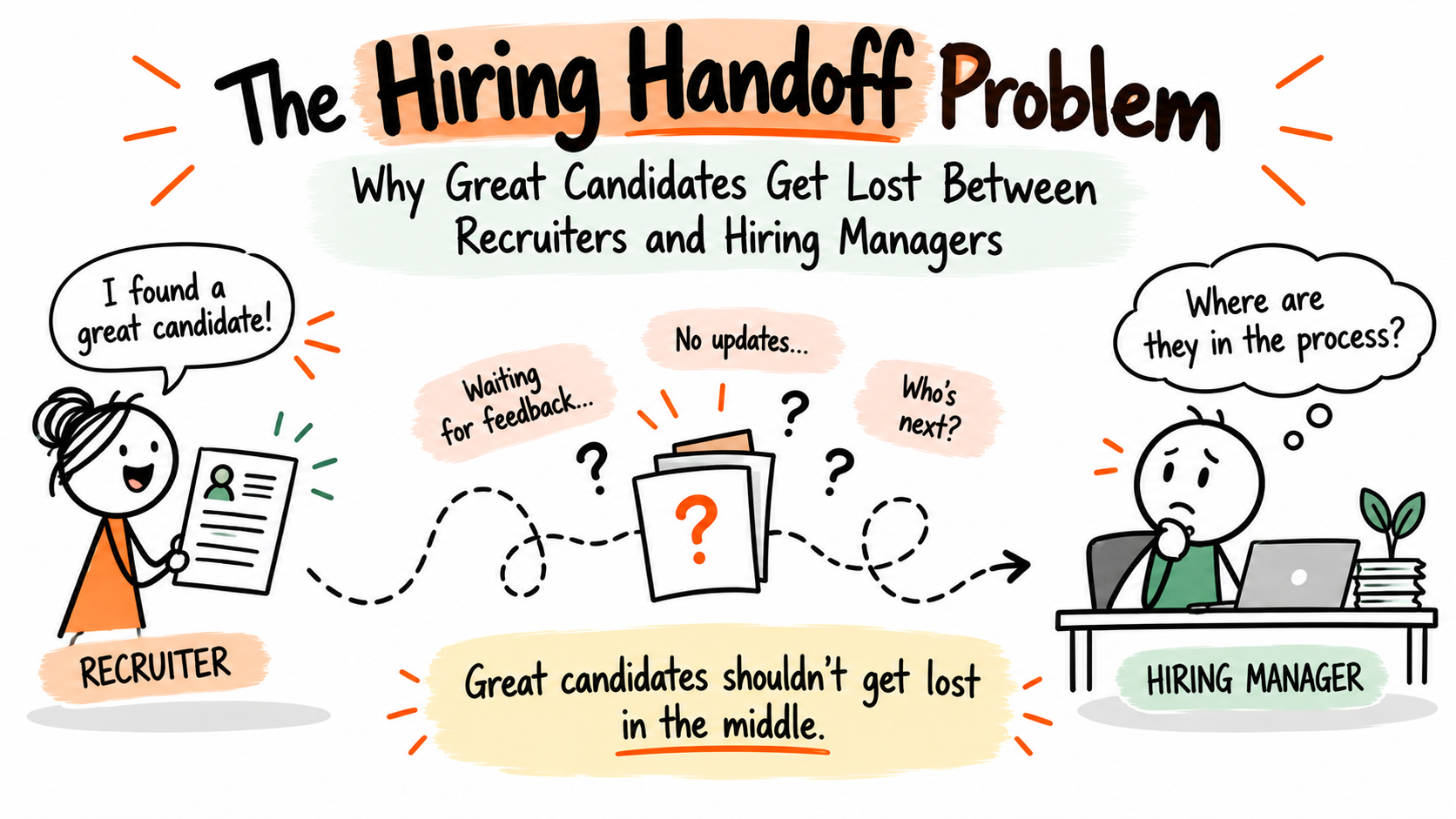
The recruiter finds someone with the right experience. The candidate is interested. The hiring manager wants to meet them. Everyone seems to be moving in the same direction.
Then the resume gets sent over.
And suddenly, the process enters a mysterious dimension where emails disappear, calendars become impossible to coordinate, and the phrase “We’re still reviewing candidates” starts making regular appearances.
A few days later, the candidate accepts another offer.
The recruiter is frustrated. The hiring manager is frustrated. The candidate has moved on. And the company is back where it started.
It is tempting to blame the recruiter for not finding enough qualified candidates or blame the candidate for losing interest. But sometimes, the real problem happens between the recruiter finding the candidate and the hiring manager making a decision.
This is the hiring handoff problem. And for small businesses and recruiting agencies, it can quietly drain time, money, and trust.
What Is the Hiring Handoff Problem?
The hiring handoff is the point where responsibility and information move between people involved in recruitment.
It can happen when:
- An external recruiter presents a candidate to a client.
- An internal recruiter sends a candidate to a department manager.
- A recruiting agency schedules an interview for a client company.
- A hiring manager passes interview feedback back to the recruiter.
- A candidate moves from screening to interviews, references, or an offer.
Each handoff creates an opportunity for something to go wrong.
The candidate’s qualifications may be misunderstood. The hiring manager may have different expectations from the recruiter. Interview feedback may be delayed or too vague to act on. Nobody may be sure who is responsible for contacting the candidate next.
None of these problems necessarily means someone is careless or incompetent. They often mean the hiring process depends too heavily on memory, scattered communication, and informal assumptions.
That is especially risky for small companies. A growing business may have an owner, an office manager, a department leader, and an outside recruiter sharing hiring responsibilities. Everyone is busy doing other jobs, and recruiting may not be anyone’s full-time responsibility.
The result? A candidate can be lost without anyone deliberately losing them.
Why Great Candidates Get Lost Between Recruiters and Hiring Managers
1. The Recruiter and Hiring Manager Never Agreed on What “Good” Looks Like
Many hiring problems begin before a recruiter searches for a single candidate.
A company tells a recruiter, “We need someone experienced, reliable, professional, and a good culture fit.” The recruiter starts sourcing. A few days later, qualified candidates are presented.
Then the hiring manager responds:
“They look good, but we’re really looking for someone with more initiative.”
Or:
“We need someone who can work independently and also manage a lot of customer interaction.”
Or the classic:
“They don’t feel like the right fit.”
Now the recruiter is trying to interpret a moving target.
The issue is not necessarily that the recruiter failed to search properly. The issue may be that the hiring team never translated broad preferences into clear, observable requirements.
Research and professional guidance on structured hiring emphasize defining job-related criteria before evaluating candidates. The U.S. Office of Personnel Management’s guidance on structured interviews explains how consistent, job-related evaluation methods can improve the quality and fairness of hiring decisions.
What to do instead: Build a hiring scorecard before sourcing
Before the recruiter begins searching, the recruiter and hiring manager should agree on:
- The three to five most important responsibilities: What will this person actually need to accomplish?
- Required skills: Which capabilities are genuinely necessary on day one?
- Trainable skills: What can a capable person learn after joining?
- Evidence of success: What would strong performance look like in the first 30, 60, or 90 days?
- Deal-breakers: Which requirements are truly non-negotiable?
For example, “good communicator” is vague. A more useful criterion might be:
“Can explain complicated information clearly to customers, document next steps, and follow up without repeated reminders.”
That gives the recruiter something specific to look for and gives the hiring manager something concrete to evaluate.
It also prevents a common problem: rejecting candidates for failing to meet expectations that were never clearly communicated in the first place.
2. The Recruiter Is Measuring Progress. The Hiring Manager Is Measuring Risk.
Recruiters and hiring managers often look at the same candidate through different lenses.
The recruiter may be thinking:
- Does this person meet the agreed requirements?
- Did they perform well in the initial screening?
- Are they interested in the opportunity?
- Can we get them into the interview process quickly?
The hiring manager may be thinking:
- Can this person handle the actual workload?
- Will they work well with my existing team?
- Can I trust their judgment?
- What happens if this hire doesn’t work out?
Neither perspective is automatically wrong. The problem occurs when the two sides never explain what they need from one another.
A recruiter may present a candidate as “highly qualified,” while the hiring manager wants to understand how that person handled a particular technical challenge. The recruiter may interpret a delayed response as a lack of interest, while the hiring manager may simply be overwhelmed with operational responsibilities.
Without a shared evaluation process, the candidate becomes the subject of two different conversations.
What to do instead: Separate evidence from impressions
Every candidate submission should answer the same basic questions:
- What requirements does the candidate meet?
- What evidence supports those qualifications?
- What questions still need to be answered?
- What should the hiring manager evaluate next?
Instead of sending only a resume and a sentence saying “Great candidate,” the recruiter might provide:
- Relevant experience and skills.
- Examples of accomplishments related to the role.
- Availability and compensation expectations, where appropriate.
- Any gaps that should be explored during the interview.
- A recommendation for the next step.
This makes the handoff more useful because the hiring manager knows what to look at rather than having to reconstruct the entire candidate story from scratch.
3. Nobody Owns the Clock
One of the most expensive misunderstandings in recruiting is assuming that someone else is handling the next step.
The recruiter sends a candidate to the hiring manager.
The hiring manager assumes the recruiter will follow up.
The recruiter assumes the hiring manager is reviewing the resume.
The candidate assumes the company is no longer interested.
Meanwhile, everyone is technically doing something. The hiring process is simply not moving.
Candidate experience research from LinkedIn Talent Solutions and guidance from the Chartered Institute of Personnel and Development highlight the importance of clear communication and a consistent recruitment process.
A candidate does not need an elaborate corporate experience. They do need to know what happens next.
What to do instead: Create a simple response agreement
The recruiter and hiring manager should agree on reasonable response expectations before the search begins.
For example:
- Candidate submissions receive an initial response within two business days.
- Interview requests are reviewed promptly.
- Interview feedback is submitted within an agreed timeframe.
- Every candidate has a clearly assigned next step.
- If the process is delayed, someone communicates with the candidate.
These are proposed operating standards, not universal legal or industry requirements. The right timing depends on the role, the company, and the hiring process.
The important part is that both sides agree to the same expectations.
A response agreement also protects the relationship between the recruiter and the client. Instead of arguing about whether someone was “too slow,” both sides can identify where the process stopped and fix the actual bottleneck.
4. Interview Feedback Is Too Vague to Be Useful
Imagine a recruiter follows up after an interview and receives this:
“The candidate was okay, but we’re not sure.”
What is the recruiter supposed to do with that?
Find someone with more experience? Someone more confident? Someone younger? Someone who answers questions differently? Someone who has worked in the same industry?
“Not a fit” may be a valid conclusion, but it is not a useful explanation.
Vague feedback creates several problems. The recruiter cannot improve the search. The hiring manager may continue interviewing candidates who have the same weaknesses. The candidate may never receive a clear update. And the company loses valuable information about its own hiring process.
The U.S. Office of Personnel Management’s structured interview guidance describes the value of evaluating candidates against consistent, job-related competencies rather than relying entirely on informal impressions.
What to do instead: Require evidence-based feedback
After each interview, ask the hiring manager to record:
- What did the candidate demonstrate well?
- What concerns remain?
- Which job-related requirement was not met?
- What evidence supports the assessment?
- What is the recommended next step?
For example, replace:
“They weren’t very confident.”
With something more specific:
“When asked to explain how they would handle an upset customer, the candidate did not provide a clear process for documenting the issue or following up. We need to explore that skill further.”
The second version gives the recruiter something actionable. It also gives the hiring team a better basis for comparing candidates.
5. Candidate Information Is Scattered Across Too Many Places
Here is a familiar hiring scenario:
- The resume is attached to an email.
- The recruiter’s notes are in a notebook.
- The hiring manager’s feedback is in a separate email thread.
- The interview schedule is in a calendar.
- The candidate’s follow-up message is in someone’s inbox.
- The final hiring decision is remembered by the person who happened to attend the meeting.
Now imagine trying to determine why a candidate was rejected six weeks ago, whether they might be suitable for another position, or whether the hiring manager ever responded.
That is not a people problem. It is an information problem.
Recruiting teams need a reliable way to keep candidate records, job details, interview activity, feedback, and next steps connected.
What to do instead: Create one shared source of truth
A centralized applicant tracking system, or ATS, can help organize the hiring process by keeping candidate information and workflow activity in one place.
For a small business or independent recruiter, the goal is not necessarily to purchase the most complicated software available. The goal is to make it easier to answer simple questions:
- Where is this candidate in the process?
- Who needs to take action next?
- What did we learn during the interview?
- What did the hiring manager decide?
- When was the candidate last contacted?
This is where GateKeeper ATS fits into the hiring handoff problem.
GateKeeper is HRmango’s applicant tracking system, built to help growing teams and recruiters organize their hiring workflows. It provides a centralized view of candidate pipelines, customizable hiring stages, candidate tracking, and tools for keeping hiring activity visible to the people involved.
Instead of asking a recruiter to search through six email threads for the latest candidate update, the team can use a shared recruiting workspace to see where the candidate stands and what needs to happen next.
GateKeeper also supports independent recruiters and recruiting agencies that need a more organized way to manage candidate pipelines and collaborate with clients.
Explore GateKeeper ATS and see how it can organize your hiring process.
6. The Candidate Is Left Waiting While the Team Figures Things Out
Recruiters and hiring managers often focus so intensely on their internal process that they forget what the candidate is experiencing.
From the candidate’s perspective, the process may look like this:
- A recruiter reaches out with an exciting opportunity.
- The candidate spends time preparing for an interview.
- The interview goes well.
- The recruiter says the company is interested.
- Then nothing happens.
One day passes. Then another. The candidate sends a polite follow-up. Still no clear answer.
Eventually, the candidate accepts another offer or decides that the company is not serious.
Even if the company eventually reconnects, the candidate may have already formed an impression of how the organization operates.
The CIPD’s recruitment guidance discusses the importance of a well-managed recruitment process and the role of communication in creating a positive candidate experience.
What to do instead: Make candidate communication part of the process
Do not treat candidate updates as something that happens only when someone remembers.
Build communication into the workflow:
- Confirm when an application or candidate submission has been received.
- Explain the next stage and who is responsible for it.
- Set realistic expectations about timing.
- Notify candidates when the timeline changes.
- Close the loop when a decision has been made.
Automation can help with routine updates, but it should support—not replace—thoughtful communication. Candidates should not receive an automated message saying “We’re excited to move forward” when nobody has actually decided to move forward.
Reliable communication is not just a candidate-experience improvement. It also helps recruiters protect their reputation and maintain trust with the people they source.
How to Build a Better Recruiter–Hiring Manager Handoff
Fixing the handoff does not require a massive transformation project. A small business can start with a few consistent habits.
Step 1: Start with a structured intake conversation
Before sourcing begins, the recruiter and hiring manager should agree on the role’s responsibilities, must-have skills, evaluation criteria, compensation range, interview process, and decision-makers.
Ask questions that reveal the real need behind the job description:
- What problem is this hire supposed to solve?
- What would make you say, “This person is succeeding,” after 90 days?
- Which skills are essential immediately?
- What could a motivated person learn?
- Who has final decision-making authority?
Step 2: Agree on what a candidate submission should include
Create a repeatable format for candidate presentations. This might include a short summary, relevant qualifications, evidence of experience, potential concerns, and recommended next steps.
The hiring manager should not have to guess why the recruiter believes the candidate is worth interviewing.
Step 3: Use consistent interview evaluation criteria
Ask interviewers to evaluate candidates against the same job-related criteria. A scorecard can help reduce inconsistent feedback and make it easier to compare candidates fairly.
For more information about structured interviewing and assessment methods, review the OPM’s structured interview resources.
Step 4: Assign every next step to a specific person
Do not write “Follow up with candidate” and assume everyone knows who owns it.
Instead, identify:
- Who is responsible?
- What action needs to happen?
- When should it happen?
- Where will the update be recorded?
One clear owner is better than three people who each assume the other two are handling it.
Step 5: Keep the process visible in an ATS
A recruiting system should make it easy to see the current status of every candidate, review notes, track interviews, and identify outstanding actions.
GateKeeper ATS can help small teams and independent recruiters centralize their hiring activity and reduce dependence on scattered spreadsheets and inboxes.
The technology does not replace good communication. It gives that communication a reliable place to live.
What Recruiters and Small Businesses Should Measure
If you want to know whether your hiring handoff is improving, do not look only at time-to-fill or the number of candidates submitted.
Track the points where the process slows down.
| Metric | What it helps reveal |
|---|---|
| Time from candidate submission to initial review | Whether hiring managers are responding promptly to recruiter submissions. |
| Time from interview to feedback | Whether the team is making timely decisions after meeting candidates. |
| Percentage of candidates with a documented next step | Whether candidates are being left in an unclear status. |
| Number of candidates lost during the interview process | Whether delays or poor communication may be contributing to candidate drop-off. |
| Reasons candidates are rejected | Whether the team is consistently applying agreed-upon hiring criteria. |
| Time spent clarifying candidate information | Whether recruiters and hiring managers have access to the information they need. |
These metrics are process-management suggestions, not universal benchmarks. Your team should establish its own baseline, identify the biggest bottleneck, and measure whether a change improves the process.
How GateKeeper ATS Can Support a Better Handoff
A well-managed hiring process needs more than a place to store resumes. It needs a way to connect people, information, and decisions.
GateKeeper ATS is designed to help growing teams and independent recruiters manage candidate pipelines without relying entirely on spreadsheets, disconnected email threads, or memory.
Depending on your workflow, an ATS can help you:
- Keep candidate information in a centralized workspace.
- Organize candidates by hiring stage.
- Make pipeline progress visible to authorized team members.
- Keep interview activity and hiring information connected to candidate records.
- Reduce the chance that an important follow-up gets buried in an inbox.
- Give recruiters and hiring managers a shared view of the recruitment process.
GateKeeper is part of HRmango’s broader approach to helping small businesses and recruiters hire more effectively. If your team needs more than software, HRmango also offers flexible recruiting services and Recruitment Process Outsourcing.
For independent recruiters and boutique recruiting firms, Talent Sourcing Support may also be useful when additional sourcing capacity is needed.
Final Thoughts: Great Recruiting Requires More Than Great Sourcing
A recruiter can find an excellent candidate. A hiring manager can recognize that the candidate has potential. A company can have a competitive offer and a genuinely good opportunity.
And the hire can still fall apart if the process between those people is unclear.
The solution is not to blame the recruiter, pressure the hiring manager, or send more resumes into the pipeline.
The solution is to build a process where everyone knows:
- What the company needs.
- What evidence matters.
- Who owns the next step.
- When communication should happen.
- Where the latest information is stored.
Because hiring is not finished when a recruiter finds a qualified candidate. It is not finished when the interview is scheduled, either.
The handoff is part of the hiring process. And when the handoff works, everyone has a better chance of making the right hire.
If your hiring process is getting slowed down by scattered information, unclear responsibilities, or missed follow-ups, it may be time to look at the system behind your recruiting.
Explore GateKeeper ATS or talk to HRmango about your hiring process.