
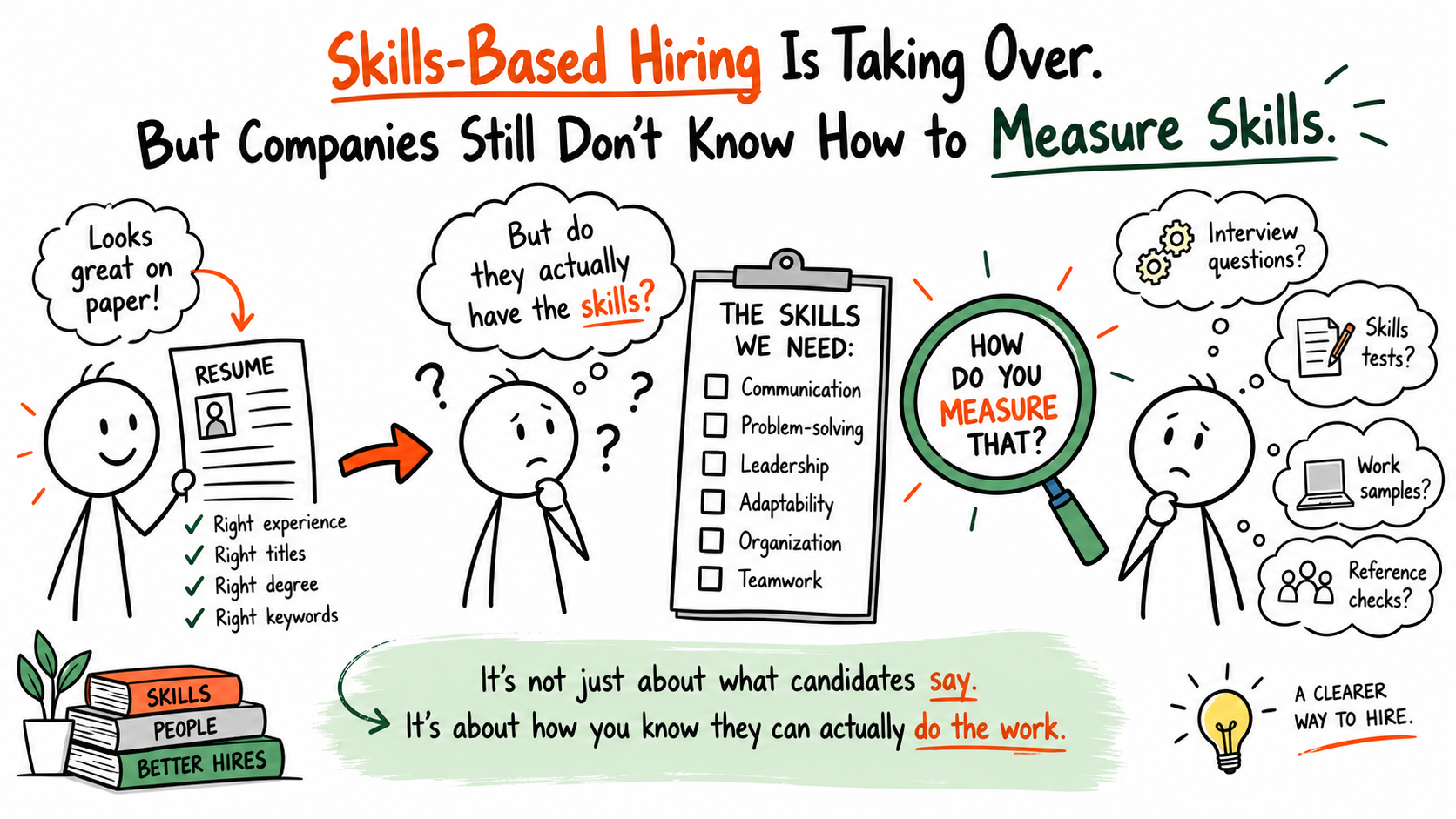
Skills-based hiring sounds simple.
Instead of asking whether a candidate has the right degree, job title, company name, or number of years of experience, you ask a better question:
Can this person actually do the work?
That sounds like an obvious improvement.
But there’s a problem hiding underneath the entire skills-based hiring movement:
How do you actually measure a skill?
It’s easy to say you want someone with strong communication skills.
It’s much harder to determine whether Candidate A has stronger communication skills than Candidate B.
It’s easy to say you want someone who can solve problems.
It’s much harder to determine whether the person sitting across from you can actually solve the problems your company will hand them on a random Tuesday afternoon.
And that is where many companies are getting stuck.
They have moved away from some of the old hiring filters, but they haven’t necessarily replaced them with a reliable way to measure what they actually want.
The result?
Companies say they hire for skills while still making decisions based largely on resumes, interviews, gut feelings, and whoever seemed like the strongest candidate that day.

Skills-Based Hiring Is No Longer a Niche Idea
This isn’t some futuristic recruiting philosophy waiting around the corner.
It’s already happening.
According to the National Association of Colleges and Employers (NACE), 70% of employers participating in its 2026 Job Outlook survey reported using skills-based hiring, up from 65% the previous year.
NACE also found that employers are using skills-based hiring most frequently during interviews and candidate screening. Employers are also incorporating skills into job descriptions and interview rubrics.
That represents a significant shift.
For years, hiring has often relied on proxies for ability:
- Degree
- Major
- Years of experience
- Previous employer
- Job title
- Industry experience
- Certifications
Those things can provide useful context.
But they aren’t the same thing as demonstrating that someone can perform the work.
NACE’s research shows this shift clearly. In 2019, 73% of employers surveyed used GPA as a screening tool. In its 2026 research, that figure had fallen to 42%.
The hiring question is changing from:
“Where did this person come from?”
to:
“What can this person actually do?”
That’s a better question.
But it creates a much harder problem.
The Problem With Saying “We’re Hiring for Skills”
Imagine you’re hiring an operations manager.
Your job description says you want someone with:
- Strong leadership skills
- Excellent communication
- Problem-solving ability
- Attention to detail
- Adaptability
- Strong organizational skills
Sounds reasonable.
Now imagine you have three candidates.
Candidate A says:
“I’m a very strong communicator and I’ve successfully managed teams for eight years.”
Candidate B says:
“My previous team consistently hit its goals, and I implemented a new workflow that reduced the number of customer escalations.”
Candidate C says:
“I’m a natural leader. People tend to come to me when there’s a problem.”
Who has the strongest communication skills?
Who is the strongest problem solver?
Who is actually the best leader?
You don’t know.
You have claims.
You have impressions.
You have stories.
But you don’t necessarily have comparable evidence.
And that distinction matters.
A Skill Isn’t Something a Candidate Says They Have
This is where skills-based hiring can go sideways.
A resume can say:
“Excellent leadership skills.”
A candidate can say:
“I’m an excellent leader.”
A reference can say:
“They were a great leader.”
But none of those statements actually measures leadership.
They’re descriptions of leadership.
There’s a difference.
If you want to measure a skill, you need to translate the skill into something observable.
Instead of:
“We need someone with strong problem-solving skills.”
Try:
“This person will regularly receive incomplete information, identify the most important issue, determine what additional information is needed, prioritize possible solutions, and make a recommendation.”
Now you have something you can actually evaluate.
You can build a question around it.
You can create a work sample around it.
You can define what strong performance looks like.
You can score it.
And you can compare candidates against the same standard.
This is the difference between listing skills and measuring skills.
The First Step Is Not Buying an Assessment
This is an important distinction.
When companies hear “skills assessment,” they sometimes jump immediately to testing software.
But the first question shouldn’t be:
“Which assessment should we use?”
The first question should be:
“What does success actually look like in this job?”
Before you can measure a skill, you need to understand what the person will actually be expected to do.
This is why a well-written job description matters.
Our guide on how to create an effective job description for a small team gets at an important part of this process: your job description should describe the actual work, not simply produce a laundry list of qualifications.
Start with the work.
Then identify the capabilities required to perform that work.
Then determine how you can observe those capabilities.
Only then should you decide how to assess them.
Turn Vague Skills Into Observable Behaviors
Here’s where the process becomes much more useful.
Take a vague skill and translate it into behavior.
| Vague Skill | What It Could Mean on the Job | What You Could Measure |
|---|---|---|
| Communication | Explains complicated information clearly to customers or coworkers | Written response, presentation, role-play, structured interview |
| Problem-solving | Identifies root causes and evaluates possible solutions | Work sample, scenario, case exercise |
| Leadership | Sets expectations, handles conflict, delegates, and holds people accountable | Behavioral interview, management scenario, role-play |
| Organization | Prioritizes competing deadlines and keeps work moving | Prioritization exercise, work sample, scenario |
| Customer service | De-escalates difficult situations while protecting company policies | Role-play, written response, situational judgment exercise |
| Data analysis | Identifies meaningful patterns and turns data into decisions | Data exercise or job-specific work sample |
Notice what changed.
We’re no longer asking whether someone says they possess a skill.
We’re asking them to provide evidence of the behavior associated with that skill.
The Best Measurement Is Usually Closer to the Actual Work
This is one of the most important ideas in skills-based hiring.
If you want to know whether someone can perform a task, giving them a realistic version of that task can tell you considerably more than simply asking whether they’ve done something similar before.
The U.S. Office of Personnel Management’s assessment guidance identifies work samples as an assessment method in which applicants perform tasks or activities that mirror work performed on the job.
OPM’s guidance also provides validity estimates for common assessment methods. Its figures put work samples at approximately .54 and structured interviews at approximately .51, compared with .18 for years of job experience and .10 for years of education when used as standalone predictors in the framework cited by OPM.
That doesn’t mean years of experience are useless.
It means experience is a proxy.
And proxies become less useful when you can directly observe the capability you’re trying to predict.
What This Looks Like in the Real World
Hiring a Salesperson
Don’t only ask:
“Tell me about your sales experience.”
Give them a realistic objection from one of your customers.
Then evaluate:
- Do they ask questions?
- Do they understand the underlying objection?
- Do they become defensive?
- Do they rush toward a discount?
- Can they explain the value?
- Can they move the conversation forward?
Now you’re observing sales behavior.
Hiring an Operations Employee
Give them a simplified version of an actual operational problem.
Maybe three things went wrong at the same time.
Ask them to determine what they would handle first and why.
Now you’re measuring prioritization and problem-solving.
Hiring an Administrative Employee
Give them five tasks with competing deadlines and incomplete information.
Ask them to explain how they would organize the work.
Now you’re seeing organization, judgment, communication, and prioritization in action.
Hiring a Manager
Give them a realistic employee conflict.
Don’t tell them the “correct” answer.
See what questions they ask first.
See whether they investigate before judging.
See how they balance accountability with coaching.
Now you’re evaluating management judgment rather than simply counting years of management experience.
But There’s Another Problem: Different Interviewers See Different Things
Let’s say three people interview the same candidate.
Afterward:
Person #1 says:
“They’re extremely confident.”
Person #2 says:
“I wasn’t sure they understood the role.”
Person #3 says:
“I really liked them.”
Now what?
The company has three opinions.
But opinions aren’t measurements.
This is one reason structured assessment matters.
The Office of Personnel Management’s guidance on structured interviews explains that structured interviews use predetermined questions and consistent rating standards tied to job-related competencies.
In other words:
Don’t just ask every candidate whatever question happens to come to mind.
Don’t let one candidate get an easy question and another get a difficult one.
Don’t score one person based on “I liked them” while scoring another based on whether they gave a specific answer.
Define the competency.
Ask the same type of question.
Use the same scoring criteria.
Then compare the evidence.
Scorecards Are More Important Than Most Companies Realize
This is where the hiring process starts becoming repeatable.
Suppose you’re hiring for an account manager position.
You identify four critical competencies:
- Customer communication
- Problem-solving
- Organization
- Relationship management
Instead of finishing the interview with:
“So…what did everyone think?”
You score each competency.
| Competency | 1 – Weak | 3 – Meets Expectations | 5 – Exceptional |
|---|---|---|---|
| Communication | Unclear or difficult to follow | Clear and appropriate | Exceptionally clear and adapts to audience |
| Problem-solving | Jumps to conclusions | Identifies reasonable solutions | Identifies root cause and evaluates tradeoffs |
| Organization | Struggles to prioritize | Creates a workable plan | Anticipates conflicts and adjusts priorities |
| Relationship management | Reactive | Maintains professional relationships | Builds trust while managing difficult situations |
Now you have something far more useful than:
“I liked Candidate A.”
You can say:
“Candidate A scored strongest in the four competencies we identified as critical to success.”
That’s a much better hiring conversation.
Don’t Let the Scorecard Become Another Checkbox Exercise
There is a trap here, too.
A scorecard isn’t useful simply because it exists.
You can create a beautiful spreadsheet with 37 categories and still make terrible hiring decisions.
The goal isn’t to measure everything.
The goal is to identify the few capabilities that actually matter.
For most roles, you probably don’t need twenty competencies.
You need to determine which skills are genuinely predictive of success and which ones are merely nice to have.
That’s an important distinction for small businesses in particular.
If you’re running a 20-person company, you probably don’t have the time to build an enormous corporate assessment center.
You need a process that is simple enough to actually use.
That’s exactly why auditing your hiring process can be so valuable. Before adding more tools, determine where your existing process is actually losing information or creating inconsistent decisions.
Skills-Based Hiring Doesn’t Mean “Ignore Experience”
This is another misconception worth clearing up.
Skills-based hiring isn’t about pretending someone’s previous experience doesn’t matter.
It is about understanding why that experience matters.
Imagine two candidates.
Candidate A has ten years of experience.
Candidate B has four years.
It would be easy to conclude that Candidate A is the safer hire.
But what if Candidate A spent ten years performing essentially the same tasks?
And Candidate B spent four years taking on increasingly difficult responsibilities, solving problems, training others, and improving processes?
Years alone don’t tell you that story.
This is why our previous article, Why Your Best Candidate Isn’t the One With the Best Resume, is relevant here.
The resume provides clues.
The assessment provides evidence.
The hiring decision should use both.
The Measurement Problem Becomes Even More Important With AI
There’s another reason this conversation is becoming more urgent.
AI has made it easier for candidates to produce polished resumes, cover letters, application responses, and other written materials.
That doesn’t automatically make those materials useless.
But it does make the difference between claiming a skill and demonstrating a skill increasingly important.
A beautifully written application can tell you that someone can produce a beautifully written application.
It doesn’t necessarily tell you how they’ll perform the job.
That’s why organizations need to think carefully about what evidence they collect.
If the job requires writing, evaluate writing.
If the job requires analysis, evaluate analysis.
If the job requires customer interaction, simulate customer interaction.
If the job requires prioritization, give the candidate competing priorities.
If the job requires decision-making under uncertainty, don’t give them a question with an obvious answer.
Measure the thing you actually need.
Our article on using AI in hiring without breaking trust, compliance, or the candidate experience explores the broader changes AI is creating in recruiting.
Be Careful: A “Skills Test” Isn’t Automatically a Good Test
This is where companies need to be thoughtful.
Just because something is called a skills assessment doesn’t mean it is a good measure of job performance.
A test can be:
- Too disconnected from the actual job
- Unnecessarily complicated
- Poorly scored
- Inconsistent between candidates
- Measuring something the job doesn’t require
- Unreasonably burdensome for applicants
The U.S. Equal Employment Opportunity Commission has emphasized that employment selection procedures should be related to the skills required for the particular job, particularly when a selection practice has disparate impact.
That principle is important even beyond compliance.
If you’re measuring something that isn’t relevant to success in the job, why are you measuring it?
A good assessment should answer a very simple question:
“Does this tell us something useful about whether this person can succeed in this specific role?”
The Best Skills-Based Hiring Process Is Usually a Combination of Evidence
There isn’t one magical assessment that will tell you everything about a candidate.
A strong process can combine several types of evidence.
For example:
- Resume/application: What has the candidate done?
- Screening: Does the candidate appear to meet the basic requirements?
- Structured interview: How has the candidate demonstrated relevant behaviors in the past?
- Work sample: Can the candidate perform a realistic version of the work?
- Reference check: Does outside evidence support what you’ve learned?
- Scorecard: How does the evidence compare across candidates?
This is very different from:
Resume → Interview → Gut feeling → Offer.
And it doesn’t have to be complicated.
A Simple Framework for Measuring Skills
If you want to move toward skills-based hiring without rebuilding your entire recruiting operation, start here.
Step 1: Identify the 3–5 skills that actually matter
Not every skill in the job description deserves equal weight.
Ask:
If this employee were excellent at only three things, what would make them successful?
Step 2: Define what each skill looks like in the real job
Don’t write “excellent communication.”
Write what excellent communication actually looks like.
Step 3: Decide what evidence would demonstrate the skill
Could you observe it through:
- A structured interview?
- A work sample?
- A role-play?
- A writing exercise?
- A technical assessment?
- A case study?
Step 4: Create a consistent scoring system
Decide ahead of time what weak, acceptable, and exceptional performance look like.
Step 5: Use the same core evaluation for every candidate
Consistency makes comparisons more meaningful.
Step 6: Keep evidence with the candidate record
This is where technology can make the process dramatically easier.
Instead of having one interviewer’s notes in a notebook, another person’s notes in email, and someone else’s scorecard sitting on their desktop, keep candidate information organized in one place.
An applicant tracking system (ATS) can help centralize applications, interview notes, candidate evaluations, communication, and hiring-stage information.
The technology doesn’t replace judgment.
It gives your judgment better information to work with.
For Small Businesses, This Matters Even More
A large corporation can survive a mediocre hire differently than a small business can.
If you have 20 employees and one person isn’t working out, that isn’t a small problem.
The manager’s time gets consumed.
Other employees pick up the slack.
Projects slow down.
Customers may notice.
And eventually you’re back where you started, except now you’ve spent months and money on the wrong hire.
That’s why small businesses shouldn’t think of skills-based hiring as an elaborate HR initiative.
Think of it as a way to reduce uncertainty.
Instead of asking:
“How do we find someone who looks qualified?”
Ask:
“How can we collect enough useful evidence to make a confident decision?”
That is a much more practical question.
Our small-business hiring system guide goes deeper into building a repeatable hiring process without creating a massive administrative burden.
The Real Shift Isn’t From Degrees to Skills
That framing is actually too simplistic.
The bigger shift is from proxy-based hiring to evidence-based hiring.
A degree can be evidence.
Experience can be evidence.
A certification can be evidence.
A resume can be evidence.
An interview can be evidence.
A work sample can be evidence.
A reference can be evidence.
The question isn’t whether one of these things is “good” or “bad.”
The question is:
How directly does this evidence tell us whether the person can succeed in the job?
That’s the question that makes skills-based hiring useful instead of just trendy.
Skills-Based Hiring Is Only as Good as Your Measurement System
Companies are moving toward skills-based hiring because the old proxies don’t always tell the whole story.
But replacing “degree” with “communication skills” doesn’t solve anything if communication skills are still being judged by whoever happened to like the candidate most.
Replacing “10 years of experience” with “strong problem-solving” doesn’t help if nobody has defined what strong problem-solving actually looks like.
And adding an assessment doesn’t make your process evidence-based if the assessment has nothing to do with the work.
The real opportunity is not simply to hire for skills.
It’s to become much better at identifying, observing, documenting, and comparing the evidence that those skills exist.
That means:
- Define the skills that actually matter.
- Translate them into observable behaviors.
- Use assessments that resemble the real work.
- Ask consistent questions.
- Score candidates against defined criteria.
- Keep the evidence organized.
- Review whether the process actually predicts good hires.
And perhaps most importantly:
Stop confusing a candidate’s ability to tell you they’re good at something with evidence that they actually are.
The resume can get your attention.
The interview can give you context.
But when you can actually observe someone doing the work, you’re no longer guessing quite as much.
And better hiring isn’t about eliminating uncertainty completely.
It’s about making better decisions with better evidence.
Sources & Further Reading
- National Association of Colleges and Employers: Employer Use of Skills-Based Hiring Practices Grows
- NACE Job Outlook 2026
- U.S. Office of Personnel Management: Developing Your Assessment Strategy
- U.S. Office of Personnel Management: Structured Interviews
- U.S. Office of Personnel Management: Work Samples and Simulations
- U.S. Equal Employment Opportunity Commission: Employment Selection Procedures
Related HRmango resources:
- Why Your Best Candidate Isn’t the One With the Best Resume
- Top 10 Skills Employers Want in 2026
- What Is an Applicant Tracking System?
- How to Create an Effective Job Description for a Small Team
- How to Audit Your Hiring Process in 30 Days
- Small Business Hiring in 2026
- AI in Hiring 2026
- How to Reduce Recruiting Costs Without Sacrificing Quality