
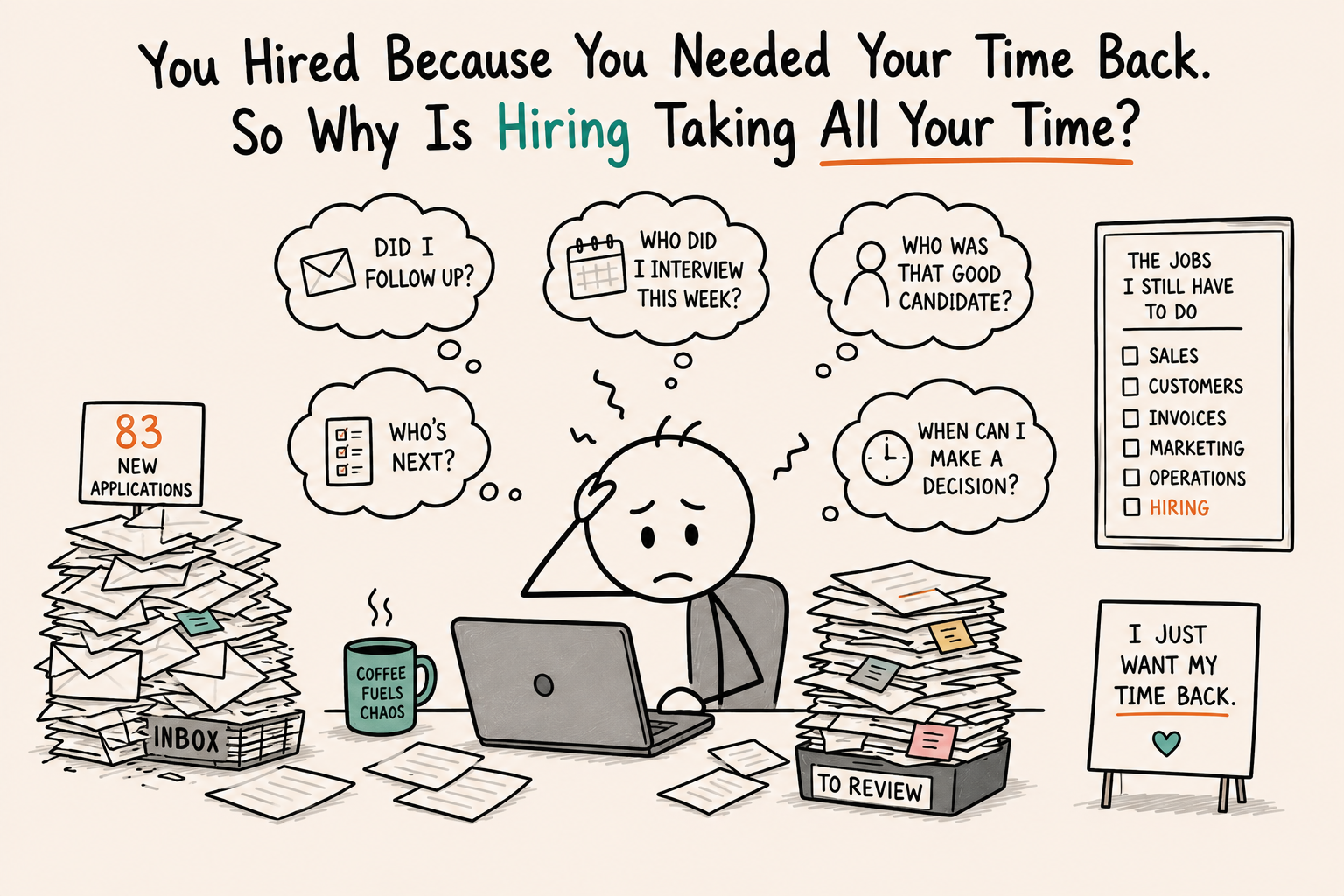
TL;DR: Most small business owners don’t start hiring because they suddenly want to become recruiters. They hire because they’re already stretched too thin. But without a hiring process, finding help creates even more work: resumes pile up, applicants are hard to compare, interviews eat into the week, follow-ups get forgotten, and good candidates can disappear before you make a decision. We call this the Hiring Paradox: you need to hire to get your time back, but hiring starts taking the little time you have left.
The answer isn’t becoming better at doing HR yourself. It’s creating a hiring process that doesn’t depend entirely on you.

You probably didn’t start your business because you dreamed of spending Tuesday night comparing resumes.
You started it to build something.
Then the business grew.
And somewhere along the way, you became the owner…
…and the salesperson.
…and customer support.
…and operations.
…and marketing.
…and the person who knows why the printer makes that weird noise.
Eventually, you reach the conclusion almost every growing business owner reaches:
I can’t keep doing everything myself. I need help.
So you decide to hire someone.
And then something ridiculous happens.
Finding the help becomes another job.
The Hiring Paradox: You Need Help Because You’re Busy. Hiring Makes You Busier.
Think about what happens after you decide to hire.
First, you need to figure out exactly what you’re hiring for.
Then you need to write the job description.
Then post it.
Then review applications.
Then decide who looks promising.
Then email them.
Then coordinate schedules.
Then conduct interviews.
Then remember what everybody said.
Then compare candidates.
Then follow up.
Then make an offer.
And you’re supposed to do all of this while still running the business that made you need another employee in the first place.
That’s what we call the Hiring Paradox.
You need another person because there aren’t enough hours in your day.
But before that person can give you some of those hours back, hiring them starts consuming the hours you have left.
“I’m Getting Applicants. Just Not the Right Ones.”
Then there’s the version of the Hiring Paradox that might be even more frustrating.
You actually are getting applicants.
Lots of them.
Your inbox is filling up.
The problem?
You don’t want to hire most of them.
Maybe they don’t have the experience you asked for.
Maybe they applied without reading the job description.
Maybe their experience looks close enough that you’re not sure whether to reject them.
Maybe you have 60 resumes and three people who actually seem worth interviewing.
Now instead of wondering where all the applicants are, you’re spending your evening searching for three promising candidates inside a pile of applications.
More applicants haven’t necessarily made hiring easier.
Sometimes they’ve just created more decisions.
We’ve written before about this strange problem in The Applicant Abundance Paradox: businesses can receive plenty of applications and still struggle to make a hire.
And this is where it’s easy to arrive at a conclusion many frustrated business owners eventually reach:
“There just aren’t any good candidates.”
Sometimes the talent really is difficult to find.
But before blaming the entire job market, it’s worth asking a different question:
Is there a candidate problem, or a process problem?
Before You Blame the Applicants, Look at What You’re Attracting
If you’re consistently attracting people who aren’t right for the job, look upstream.
Your applicant pool starts with what you’re putting into the market.
Is the job title clear?
Does the job description explain what the person will actually do?
Are the qualifications realistic?
Is compensation clear?
Can someone quickly understand why they would want this job?
Are you posting where the people you want to reach are actually looking?
A vague job description can attract a vague applicant pool.
And a job description that tries to appeal to everyone can create exactly the problem you’re trying to avoid: more applications to sort through without more people you actually want to interview.
If this sounds familiar, start with our guide to creating an effective job description for a small team.
And Then There’s the Candidate You Never Noticed
Here’s another possibility.
The right candidate applied.
You just haven’t found them yet.
Their resume came in Tuesday.
You skimmed it between meetings.
You thought:
“This one looks interesting. I’ll come back to it.”
Then a customer called.
Wednesday got busy.
Thursday disappeared.
Now it’s Friday and you’re trying to remember:
“Wait…which candidate was that?”
This is where applicant volume becomes particularly dangerous for small teams.
The issue isn’t simply how many applications you receive.
It’s whether you have a reliable way to move the right people through them.
If every resume looks like another email, every promising applicant becomes another thing you’re trying to remember.
Small Business Owners Aren’t Bad at Hiring. They’re Usually Hiring Without Infrastructure.
Large companies typically have people, processes and technology dedicated to recruiting.
A small business might have…
you.
And your inbox.
That’s an enormous difference.
Yet small business owners often expect themselves to somehow reproduce the same result while also running the rest of the company.
You don’t need to become a professional recruiter overnight.
And you don’t necessarily need a full HR department.
But once you’re hiring regularly, you do need somewhere for hiring to live.
Not your memory.
Not sticky notes.
Not a collection of emails with stars beside them.
A system.
The Hidden Cost of Running Hiring From Memory
We’ve written about this before, and we call it Hiring Debt.
Hiring Debt accumulates when small shortcuts become the process.
“Just email me the resume.”
“I’ll remember what we talked about.”
“I’ll follow up tomorrow.”
“We’ll get organized after this hire.”
None of these decisions feels catastrophic.
That’s exactly why they’re so easy to make.
But eventually the shortcuts pile up.
You forget whether someone received a response.
Two managers evaluate candidates differently.
A promising resume gets buried.
Nobody knows where a candidate stands.
The entire hiring process pauses because the person who knows everything is out sick.
That’s when hiring stops being a repeatable business function and becomes something one person is carrying around in their head.
And if you’re already the owner, salesperson, problem solver and unofficial HR department, that’s the last place hiring needs to live.
You can learn more about recognizing these problems in our guide to auditing your hiring process.
“Nobody Will Care About My Business As Much As I Do.”
Maybe they won’t.
You’re the owner.
You built it.
You know what customers expect.
You know which details matter.
You know what “good enough” looks like and when something absolutely isn’t.
That makes handing work to another person uncomfortable.
And after one bad hire?
It gets even harder.
It’s tempting to think:
“If I want it done right, I should probably just do it myself.”
But there’s a problem with that strategy.
You don’t scale.
There are only so many hours you can personally sell, manage, fix, answer, review and approve.
The goal of hiring isn’t finding another version of you.
It’s identifying what the role actually requires and creating a consistent way to evaluate people against those requirements.
That’s why structure matters.
If every interview is an improvised conversation based on whoever happens to be conducting it, you’re making an already difficult decision even harder.
You Don’t Need an HR Department. You Need a Repeatable Hiring Process.
This is where small businesses sometimes overcorrect.
They assume their choices are:
A) Keep hiring through email and spreadsheets.
or
B) Buy some enormous enterprise recruiting system built for a company with 4,000 employees.
There’s a lot of room between those two options.
An applicant tracking system (ATS) simply gives your hiring process somewhere to live.
Instead of trying to remember:
- Who applied
- Who looks promising
- Who has been contacted
- Who needs an interview
- What happened during that interview
- Who needs follow-up
- Who is still being considered
…you can track those things in one place.
That’s especially valuable when your business doesn’t have a dedicated HR person.
If you’re wondering whether your company is big enough to need one, read Which Applicant Tracking System Makes Sense for Small Businesses?.
You can also see how an ATS fits into the earliest stages of growth in How to Use an ATS to Hire Your First 10 Employees.
Which Hiring Problem Do You Actually Have?
Here’s the question we’d encourage every overwhelmed small business owner to answer:
“I can handle hiring. I just need to organize it.”
If you know how to find and evaluate candidates but you’re losing track of resumes, conversations, interview notes and follow-ups, your problem may primarily be process.
That’s exactly what an applicant tracking system is designed to help solve.
GateKeeper gives small businesses one place to organize candidates and their hiring pipeline without requiring a giant enterprise recruiting stack.
And because GateKeeper is free for up to five users, a small team doesn’t have to wait until hiring is completely out of control to start building a process.
“I don’t have time to find these people in the first place.”
That’s a different problem.
Maybe the role is difficult to fill.
Maybe you’re getting applicants but consistently getting the wrong applicants.
Maybe you don’t have time to source candidates, screen them and manage the recruiting workload.
In that case, software alone isn’t the answer.
You may need recruiting support.
HRmango offers on-demand recruiting, fractional recruiting and other recruiting solutions designed to give businesses help without forcing them into a one-size-fits-all recruiting model.
“Honestly? Both.”
That’s normal too.
You may need help finding the right candidates and a better way to manage what happens once those candidates enter your pipeline.
The important thing is recognizing that those are two different problems.
One requires organization.
The other requires recruiting capacity.
And sometimes you need both.
Hiring Is Supposed to Give You Capacity, Not Consume It
There is a strange moment in the growth of a small business when success starts creating its own problems.
You have enough work to need help.
But not enough infrastructure to make getting that help easy.
That’s where many owners get stuck.
They don’t need another motivational speech about working harder.
They’re already working hard.
They need parts of the business to stop depending entirely on them.
Hiring is one of those parts.
Because the goal was never to become better at juggling resumes.
The goal was to build a team capable of helping you carry the business.
And that starts by building a hiring process capable of carrying some of the weight, too.
Get Hiring Out of Your Head
If your hiring process currently lives across your inbox, calendar, notes and memory, you don’t need to wait until you’re a large company to organize it.
Try GateKeeper free for up to five users and give your candidates, notes and hiring pipeline one place to live.
And if your problem isn’t organizing candidates because you don’t have enough time to find the right candidates in the first place, talk with HRmango about recruiting support.
You started hiring because you needed your time back.
Let’s make sure hiring isn’t the thing taking it away.