
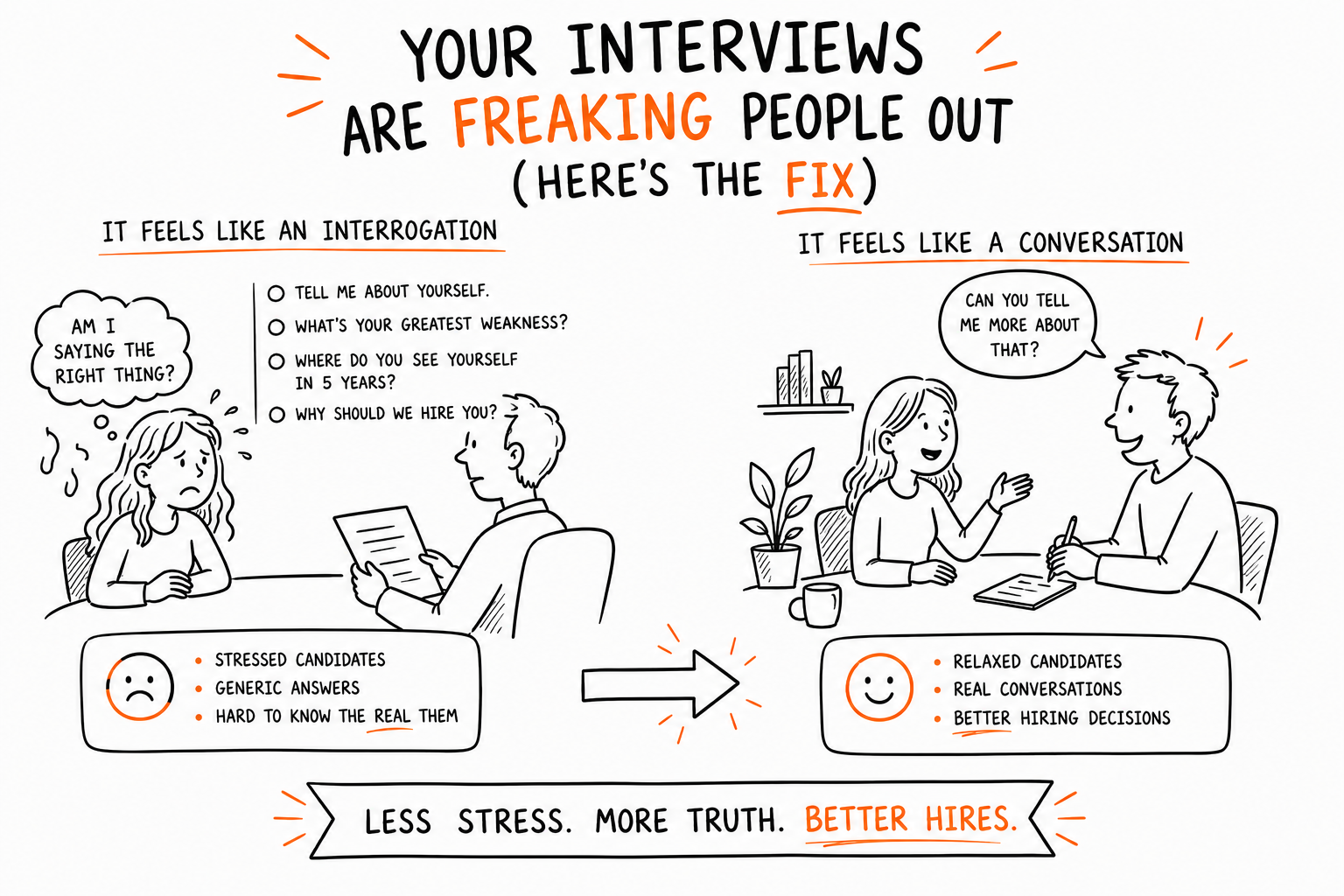
TL;DR: “Tell me about a time when…” isn’t broken. Reading it off a script like a robot is. Here’s how to ask the same smart questions without making candidates feel like they’re on trial.
Your interviews are freaking people out. That’s the problem.
Here’s a stat that should bug you: 46% of new hires fail within 18 months. Most of the time, it’s not because they couldn’t do the job. It’s because the interview never really found out if they could.
Almost every candidate walks in already nervous. Studies show interview anxiety alone can tank someone’s performance by up to 30% — and that’s before you’ve even asked a question. Then you hit them with “tell me about a time you failed,” read straight off a sheet in a flat voice, and boom. You just proved their fear right. This isn’t a conversation. It’s an interrogation.
And it’s not just nerves in their head messing with them — it messes with how you see them too. In one study, candidates who looked more anxious got rated as less competent, even when they said the exact same words as a calmer candidate. So at that point, you’re not scoring skill. You’re scoring who’s better at hiding sweaty palms.
Okay, real talk: the questions aren’t the villain here
Let’s be straight with you, because we’d rather you know the real story than a comfortable one.
“Tell me about a time…” questions work. The research backs them up, hard. Interviews that use the same solid questions and the same scoring for every candidate actually predict who’ll succeed on the job. One major study found structured interviews scored a 0.51 for accuracy, compared to just 0.38 for loose, unstructured chats — and newer research says the gap is even bigger. So no, just “vibing” with a candidate for 30 minutes isn’t the fix. It actually makes your hiring worse.
So what’s actually broken? Not the question. How you ask it. A stiff, formal question basically hands the candidate the “right” answer before they open their mouth. Ask “describe a time you successfully handled stress” and nobody’s going to say “actually, I lost it and my manager had to clean up my mess.” You told them exactly what story to tell. Now stick that candidate in a room where they already feel watched and judged, and it gets worse. In one study on technical interviews, people solving the same exact problem did less than half as well when someone was watching them, compared to working alone. Same person. Same skill. Totally different result, just because the room felt like a spotlight.
So here’s the move: keep the good questions. Lose the courtroom energy.
How to actually do this (not just “be more chill”)
Step 1: Pick 3 or 4 things you actually care about
Before the interview, don’t try to test everything. Pick 3-4 things that actually matter for this job — maybe ownership, staying calm under pressure, and playing well with others. Build 5-8 questions around those. If you’ve got a panel of interviewers, split it up. Give each person 2-3 things to dig into so you’re not all asking the same question and wasting everyone’s time.
Step 2: Stop asking questions like you’re reading a script
Same question underneath. Wildly different answer depending on how you ask it. Here’s what that looks like when you swap the stiff version for something you’d actually say out loud:
| Stiff version (skip this) | Say this instead |
|---|---|
| “Describe a time when you needed to exercise problem-solving under pressure.” | “Tell me about a time everything hit the fan at once. What happened?” |
| “Tell me about a time you demonstrated leadership.” | “Ever had to get people moving on something when you weren’t even the boss? How’d you pull that off?” |
| “Give an example of a conflict you successfully resolved with a coworker.” | “Tell me about a coworker you just didn’t click with. How’d you two make it work anyway?” |
| “Tell me about a time you failed.” | “What’s something you got wrong at work that actually changed how you do your job now?” |
| “Describe a time you successfully managed competing priorities.” | “Tell me about a week where everything felt urgent. How’d you figure out what actually was?” |
See the pattern? The stiff version basically says “give me your success story.” The casual version doesn’t promise a happy ending — so candidates stop performing and start telling you what actually happened. That’s the whole point.
Step 3: Use S.T.A.R. to listen, not to quiz them
You don’t need to teach candidates the STAR method (Situation, Task, Action, Result). A lot of them already know it, and that’s fine. Your job is just to listen for all four pieces while they talk, and nudge if one’s missing:
- They skip straight to the action → “Wait, back up — what was actually going on that made you need to do that?”
- They keep saying “we” instead of “I” → “Sure, but what did you specifically do, versus the rest of the team?”
- The story just… stops → “Okay so how’d that actually turn out? How’d you know it worked?”
- Everything’s vague → “Can you get more specific? Like, what did you actually say to them?”
These little nudges do two jobs at once. They get you the details you need to actually score the answer, and they’re basically impossible to rehearse ahead of time. That’s how you tell a real story from a memorized one. And if the story falls apart the second you push on it? That tells you something too.
Step 4: Push hard enough to matter. Not hard enough to be mean.
Glassdoor looked at over 150,000 interviews and found the sweet spot for difficulty is a 4 out of 5 — challenging enough to feel real, not so brutal it feels like hazing. Interviews rated a full 5 out of 5 actually left candidates less satisfied than a 4. So dig. Push back on vague answers. Don’t let people off easy. Just don’t turn it into a competition to see who can make the candidate squirm the most.
Step 5: Score it right after, on your own, before you talk to anyone
This is the step most “keep it casual” advice skips completely, and it’s the one that actually keeps things fair. Right after the interview — not at 5pm after five back-to-back interviews blur together — score each competency 1 to 5, and jot down one line of proof for the number. Compare notes with the rest of your team after everyone’s scored on their own, not before. This is what keeps a relaxed conversation from turning into “eh, I just liked them better.” The rubric does the hard work so the conversation doesn’t have to.
None of this sticks without a place to put it
Here’s the catch. The more natural your interviews get, the easier it is to lose track of everything. If your notes are scattered across sticky notes, a random Slack thread, and “I think it was Sarah with the good story about the fire drill”… you don’t have a hiring process. You have vibes with extra steps. This is exactly the kind of mess that quietly wrecks your hiring results, and it’s usually the first thing worth cleaning up.
When your questions, scorecards, and notes live in one spot before you even walk in, you get to actually be present with the person in front of you instead of scrambling to remember your own rubric mid-sentence. That’s the whole point of a decent ATS. Not to make hiring feel more corporate — to get out of your way so the conversation and the rigor can both happen at the same time.
Speaking of getting out of your way…
Most ATS software makes you pay enterprise prices before you’ve even hired your first 10 people. GateKeeper flips that.
Your first 5 user seats? Completely on the house. Not a “free trial that quietly turns into a bill.” Just free, for as long as you’re a growing team. You only start paying once your team actually grows past that.
No sneaky fees. No hostage situations where your candidate notes and scorecards get locked behind a paywall right when you need them most. Just simple pricing that grows when you grow — not before.
And if you’re still handing over 20%+ of a new hire’s salary to a recruiting agency for stuff your own ATS could handle? That’s not a fee. That’s a tax. It’s INSANE. Here’s exactly how to cut that cost without cutting quality.
Not sure your process can even handle this yet? Start with the 5 metrics that reveal your recruiting process is broken, or check out which ATS actually makes sense for a business your size before you commit to anything.