
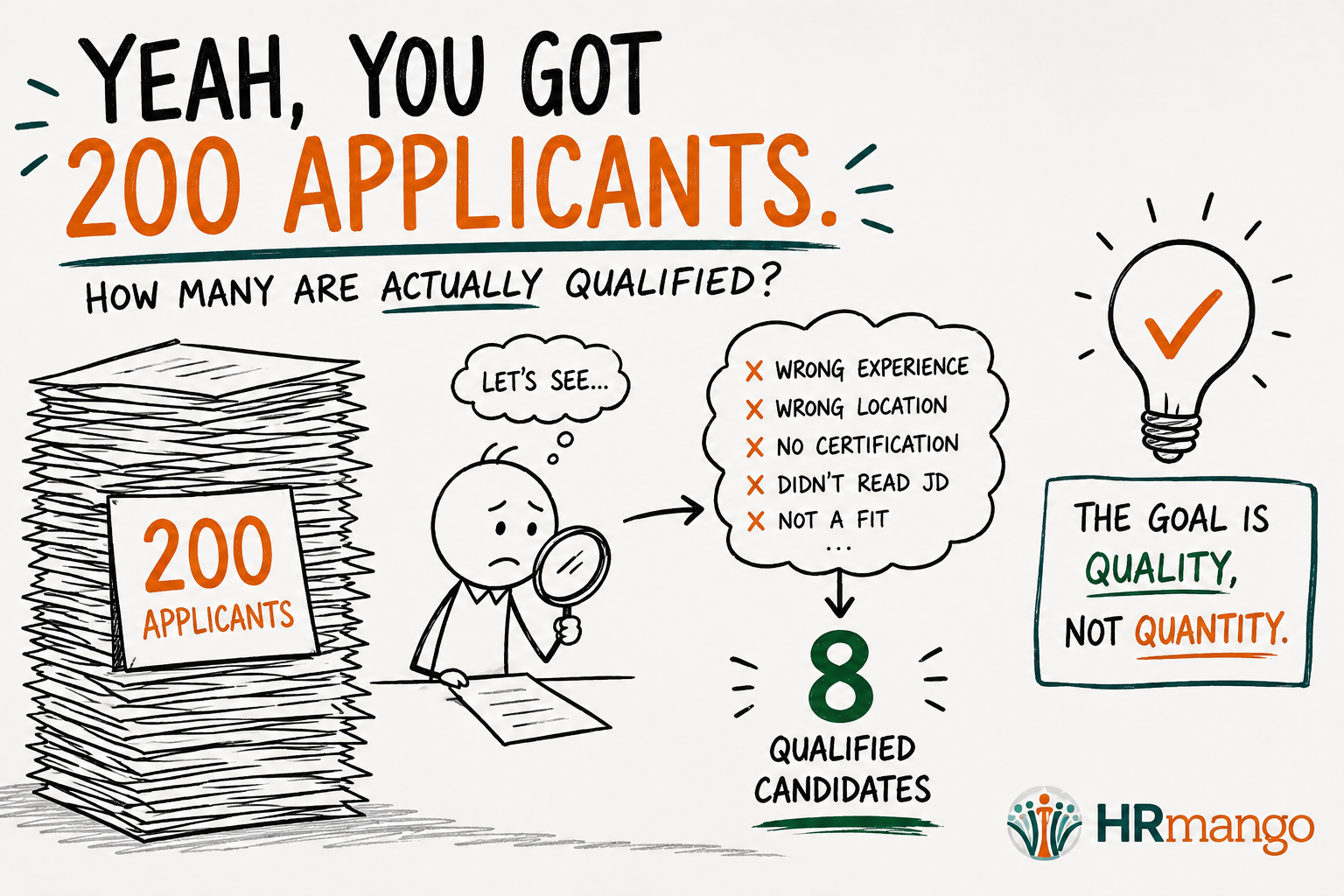
You finally posted the job.
Then the applications started coming in.
20.
50.
100.
Maybe more.
For about five minutes, it feels like you have a good problem.
Then you start opening resumes.
And the feeling changes.
Wrong experience. Wrong industry. Missing the skills you actually need. People who clearly didn’t read the job description. Candidates who look impressive until you realize they don’t actually meet the requirements.
Suddenly, your “great applicant pool” is another pile of work sitting on your desk.
If this sounds familiar, you’re not alone.
But here’s the part that matters:
A large applicant pool does not necessarily mean you have a strong recruiting pipeline.

Sometimes it means your hiring process is attracting the wrong people, filtering the wrong things, or asking you to do far too much manual work after the applications arrive.
And before you spend another dollar on a job board, recruiter, or recruiting software, it’s worth figuring out where the problem is actually coming from.
The Unqualified Applicant Problem Is Bigger Than You Think
Employers have been dealing with candidate-quality problems for years, but the problem hasn’t disappeared as application technology has made it easier to apply.
In an Indeed survey of employers, 62% said receiving too many applications from unqualified candidates was their biggest hiring challenge. Almost half of the employers surveyed said they had revised a job description after posting it because they were receiving too many unqualified applicants.
iHire’s 2025 State of Online Recruiting research found a similar pattern: 59.7% of employers said they receive too many unqualified applicants when recruiting through job boards or recruiting platforms.
So if you’re sitting there wondering, “Why am I getting 150 applications and still can’t find three people worth interviewing?” you’re not imagining the problem.
The more important question is:
Why are those 150 people getting into your funnel in the first place?
First: Don’t Blame the Applicants
This is where hiring managers can accidentally diagnose the wrong problem.
It is easy to look at a pile of bad applications and think:
“Nobody wants to work anymore.”
Or:
“People are applying to everything.”
Or:
“There just aren’t any good candidates.”
Sometimes those things may play a role.
But your applicant pool is also a reflection of what you told the market you were looking for.
If your job posting is vague, you’re going to get vague matches.
If your requirements describe your dream candidate instead of what someone actually needs to succeed, you’re going to eliminate people who could do the job.
If the posting doesn’t clearly explain what the person will actually be doing, candidates are forced to guess.
And if the application process makes it almost effortless to apply, you shouldn’t be surprised when people apply with minimal consideration.
In other words:
Your applicant pool doesn’t just happen to you. Your hiring process creates it.
Before You Fix Your Applicant Problem, Find Out Which Problem You Actually Have
There are at least five different reasons a company can end up with a mountain of unqualified applications.
And each one requires a different fix.
Problem #1: Your Job Description Is Too Broad
This is one of the easiest problems to overlook.
Take a job description that says:
- Strong communication skills
- Team player
- Detail-oriented
- Self-starter
- Ability to multitask
- Strong organizational skills
Almost everybody can convince themselves they qualify.
That’s because none of those requirements tells the candidate what they will actually have to accomplish.
Compare that with:
- Manage 30–40 customer accounts
- Respond to customer issues within one business day
- Maintain account records in the company’s CRM
- Prepare weekly account reports
- Resolve billing and service issues independently
Now the candidate has something concrete to compare themselves against.
That’s why a strong job description should start with the outcome you need from the person, not a giant shopping list of personality traits.
We’ve written more about this in our guide to creating an effective job description for a small team.
Problem #2: Your “Must-Haves” Aren’t Actually Must-Haves
This one can quietly destroy your candidate pool.
Hiring managers often build requirements by adding everything they would like to have.
Five years of experience.
A specific degree.
Industry experience.
Experience with three different software platforms.
Leadership experience.
Certifications.
And maybe a few “nice-to-haves” that somehow become mandatory.
The result?
You can simultaneously have too many applicants and too few qualified applicants.
That sounds contradictory, but it isn’t.
You may be attracting hundreds of people while filtering out the smaller group of candidates who could actually succeed because your requirements don’t distinguish between essential and preferred.
SHRM’s 2025 Talent Trends research illustrates why this matters. Among organizations that removed college degree requirements from certain positions, more than three-quarters reported successfully hiring candidates who previously would have been considered unqualified.
The lesson isn’t “remove all requirements.”
The lesson is:
Make sure every requirement has a reason.
Ask:
- Does this person actually need this on day one?
- Does it predict whether they can perform the job?
- Can the skill be learned after hiring?
- Are we requiring it because the job needs it, or because we’ve always listed it?
Problem #3: Your Job Posting Doesn’t Tell the Right Person to Apply
A good job posting isn’t just a list of qualifications.
It is also a filtering mechanism.
The candidate should be able to read it and think:
“Yes. That’s me.”
Or:
“Actually, that’s not me.”
Both outcomes are useful.
If you’re only trying to make the job posting attractive to as many people as possible, you can accidentally optimize for application volume instead of applicant quality.
Be specific about:
- What the person will actually do
- What success looks like
- What experience is truly required
- What can be learned
- Who they will work with
- What the schedule or work model looks like
- Compensation when appropriate
- What makes someone successful in the role
You’re not trying to convince everyone to apply.
You’re trying to help the right people recognize themselves.
Problem #4: You’re Relying on the Job Board to Do Your Recruiting
This is a big one for small businesses.
You post the job.
You wait.
Applications appear.
You hope one of them is great.
That’s not really recruiting.
That’s advertising and hoping.
Job boards can absolutely be useful. But a job posting only reaches people who are looking in that particular place, at that particular time, and who happen to respond to your posting.
Some of the strongest candidates may already have jobs.
They may not be actively searching.
They may never see your posting.
They may see it and decide that applying through another giant application portal isn’t worth their time.
That’s why recruiting organizations increasingly use a mix of inbound applicants, referrals, direct sourcing, networking, niche communities, and other channels.
HRmango’s guide to finding high-quality candidates goes deeper into this approach.
If the only people entering your pipeline are the people who clicked “Apply,” your pipeline may be much smaller than it looks.
Problem #5: You Actually Have Qualified Applicants. You Just Can’t Find Them.
This is the sneaky one.
Sometimes the problem isn’t that your applicants are unqualified.
It’s that your process makes it difficult to identify the qualified ones.
Imagine this:
You have 127 applicants.
They’re sitting across email attachments, a job board inbox, a spreadsheet, a manager’s inbox, and perhaps a few resumes somebody downloaded to their desktop.
Candidate #84 might actually be excellent.
But nobody has gotten to #84 yet.
That’s not an applicant-quality problem.
That’s a process problem.
And this is where applicant tracking systems can become useful.
Not because software magically creates better candidates.
It doesn’t.
A good ATS simply gives you a place to organize the candidates you already have, move them through consistent stages, record notes, coordinate hiring managers, and make sure good candidates don’t disappear into someone’s inbox.
Our guide on what an applicant tracking system actually does explains the basics.
The 5-Minute Applicant Quality Audit
Before you change your job board, rewrite your entire recruiting strategy, or blame the labor market, take your last 25 applicants and run this quick audit.
Step 1: How Many Actually Met the Minimum Requirements?
Don’t use “I liked them.”
Don’t use “They seemed promising.”
Use the requirements you actually established for the job.
For each applicant, mark:
- Qualified
- Potentially qualified
- Not qualified
Now calculate the percentage.
If 2 out of 25 applicants were genuinely qualified, your problem deserves investigation.
Step 2: Find the Most Common Reason People Were Rejected
Look at your rejected applicants.
What keeps showing up?
- Missing certification?
- Not enough experience?
- Wrong industry?
- Wrong location?
- Salary mismatch?
- Wrong schedule?
- Missing technical skill?
- Degree requirement?
If the same rejection reason appears over and over, you’ve found a clue.
Step 3: Compare That Reason With Your Job Posting
Here’s where things get interesting.
Was that requirement obvious in the job posting?
If you rejected 18 applicants because they didn’t have a particular certification, but the certification was buried halfway down a giant paragraph, your applicant problem may be partly a communication problem.
If you rejected candidates because they couldn’t work your required schedule, but the schedule wasn’t clearly stated, same problem.
If you’re rejecting people for something that wasn’t actually listed?
You may be screening for a requirement that candidates never knew existed.
Step 4: Look at Where Your Best Candidates Came From
This is one of the most useful numbers you can track.
Don’t just track how many applications you receive.
Track where your qualified applicants came from.
| Source | Applicants | Qualified | Interviews | Hires |
|---|---|---|---|---|
| Job Board A | 100 | 4 | 2 | 0 |
| Employee Referral | 8 | 5 | 4 | 1 |
| Direct Sourcing | 15 | 7 | 5 | 1 |
| Company Website | 25 | 3 | 2 | 0 |
Now you have something much more useful than “we received 148 applications.”
You know which channels are actually producing candidates worth talking to.
Volume is a recruiting metric. It isn’t the recruiting outcome.
Then Look at Your Application Funnel
Once you’ve identified where your applicants come from, follow them through the process.
A simple hiring funnel might look like:
- Applicants
- Minimum qualifications met
- Phone screens
- First interviews
- Final interviews
- Offers
- Hires
Now ask where the funnel collapses.
If 200 people apply and only 5 meet the minimum qualifications, your problem is probably happening before the interview.
If 50 people qualify but only 2 make it through interviews, your assessment process deserves attention.
If 10 great candidates reach the offer stage and 7 reject you, you may have a compensation, candidate experience, speed, or role-expectation problem.
This is why simply saying “we can’t find good people” isn’t very useful.
You need to know where good candidates are disappearing.
Don’t Make Your Screening Process So Strict That You Screen Out Good People
There is another trap here.
Once you’ve been burned by too many bad applicants, the natural reaction is to build a bigger wall.
More knockout questions.
More requirements.
More filters.
More automated rejection.
More reasons to say no.
That can reduce the number of applications.
But fewer applicants isn’t automatically better.
You can build a funnel so restrictive that you successfully eliminate the problem of too many applicants while also eliminating the candidate you actually needed.
The goal isn’t:
“Get fewer applicants.”
The goal is:
“Get a higher percentage of relevant applicants and identify the strongest ones efficiently.”
That distinction matters.
What Should You Actually Screen For?
This is where hiring gets much more interesting than resume matching.
Before you build your screening questions, identify the things that actually matter for success in the job.
The U.S. Office of Personnel Management recommends beginning with job analysis to identify the tasks and competencies critical to the position, then selecting the competencies that should actually be assessed.
That means asking:
- What does this person have to be able to do?
- What knowledge is truly required on day one?
- What behaviors separate strong performers from weak ones?
- What can we teach?
- What would cause someone to fail in this role?
Then build your screening and interview process around those things.
That is far more useful than simply looking for a collection of keywords on a resume.
Use Consistent Screening Criteria
Once you’ve identified the competencies that matter, evaluate candidates against the same basic criteria.
This doesn’t mean turning your hiring process into a robotic interrogation.
It means avoiding the trap where Candidate A gets judged on communication, Candidate B gets judged on experience, and Candidate C gets judged on whether the hiring manager “liked their personality.”
OPM’s research on structured interviews shows that higher levels of structure are associated with stronger validity, reliability, and agreement between evaluators. Structured interviews use predetermined questions and consistent rating standards tied to job-related competencies. :contentReference[oaicite:4]{index=4}
In other words:
You don’t need to make hiring colder. You need to make your decisions clearer.
And Be Careful With Automated Filters
Technology can make screening dramatically easier, but automation doesn’t eliminate the responsibility to make sure your screening criteria are appropriate.
The EEOC notes that employment tests and other selection procedures can create legal problems if they discriminate intentionally or disproportionately exclude protected groups without being job-related and consistent with business necessity. Employers should ensure that selection procedures are properly validated for the positions and purposes for which they’re being used.
That doesn’t mean you shouldn’t use screening questions or technology.
It means your filters should have a reason.
Don’t automate a bad hiring decision. You’ll just make the bad decision faster.
What a Healthy Applicant Funnel Actually Looks Like
There isn’t one magic applicant-to-hire ratio that every business should chase.
A sales representative, nurse, software engineer, warehouse associate, and executive are not going to produce identical recruiting funnels.
Instead, watch the relationships between your stages.
A healthy process should help you answer questions like:
- Which recruiting sources produce qualified applicants?
- Which sources produce interviews?
- How many qualified applicants make it to an interview?
- Where are candidates dropping out?
- How long does each stage take?
- Which hiring managers consistently move candidates forward?
- Which jobs generate lots of applications but very few qualified candidates?
Once you have those numbers, “we aren’t finding good people” becomes a solvable business problem.
Where an ATS Fits Into This
An ATS isn’t going to make an unqualified applicant suddenly qualified.
It won’t fix a terrible job description.
It won’t make an unrealistic salary competitive.
And it won’t replace good recruiting judgment.
What it can do is give you the infrastructure to actually run the process you’ve designed.
Instead of managing candidates through scattered emails and spreadsheets, an applicant tracking system can give your team a central place to:
- Collect applicants
- Track hiring stages
- Record candidate notes
- Manage interview progress
- Keep hiring managers aligned
- Track candidate communication
- See where candidates are getting stuck
That’s the philosophy behind GateKeeper ATS.
It was built for small businesses that don’t necessarily need an enormous enterprise recruiting system. GateKeeper gives small teams a centralized hiring pipeline, and the first five user seats are currently free.
But here’s the important part:
Software should support your hiring process, not become your hiring process.
And Sometimes the Problem Isn’t Your Software Either
Maybe you’ve already got an ATS.
Maybe you’ve got a job board.
Maybe you’ve got spreadsheets.
Maybe you’ve got all three.
If the real problem is that nobody has time to source candidates, screen resumes, build a pipeline, or manage the recruiting process, buying another piece of software isn’t necessarily going to solve it.
That’s where recruiting support can make sense.
HRmango’s fractional recruiting services are designed for small and growing businesses that need recruiting expertise without hiring a full-time recruiter or paying a traditional percentage-based agency fee.
And the two pieces can work together:
GateKeeper gives you the infrastructure. Recruiting support gives you the extra hands and expertise when you need them.
The Real Goal Isn’t More Applicants
This is probably the biggest mindset shift to make.
Stop celebrating the number of applications by itself.
Two hundred applications aren’t necessarily better than twenty.
Five hundred resumes aren’t a victory if your hiring manager has to spend twelve hours finding three people worth interviewing.
And a job posting that generates a mountain of applications isn’t necessarily successful if the people applying don’t resemble the person you actually need.
The real goal is much simpler:
Get the right people into the funnel, identify them quickly, evaluate them fairly, and keep the process organized enough that you don’t lose them along the way.
That’s hiring.
Your Next Hiring Experiment
Before you post your next job, try this.
- Write down the 3–5 things that actually predict success in the role.
- Separate true requirements from preferences.
- Rewrite the job description around outcomes and real responsibilities.
- Make the deal clear: pay, schedule, location, expectations, and what the person will actually do.
- Choose the recruiting channels based on where qualified candidates are likely to exist, not simply where it’s easiest to post.
- Add a simple, job-related screening step where it makes sense.
- Track qualified applicants by source.
- Track where candidates fall out of the funnel.
- Keep your candidates, notes, interviews, and decisions in one place.
- Review the numbers after the hire and improve the process before opening the next requisition.
That last step is the one most small businesses skip.
They hire someone.
Close the job.
Move on.
Then six months later they have the same hiring problem all over again.
Because Your Applicant Problem Might Actually Be a Process Problem
If you’re getting hundreds of applications and almost none of them are qualified, don’t immediately assume the talent market has failed you.
Look upstream.
Look at the job description.
Look at the requirements.
Look at your recruiting sources.
Look at your screening criteria.
Look at your funnel.
And look at what happens to candidates after they apply.
You may discover that the problem isn’t that there aren’t good people out there.
The problem is that your hiring system isn’t doing a good enough job finding them.
And that’s a much better problem to have.
Because systems can be fixed.
Need help figuring out where your hiring process is breaking?
Start with our 30-day hiring process audit, or explore fractional recruiting if you need experienced recruiting help without adding a full-time recruiter to your payroll.
If your team is ready to get the process organized, you can also try GateKeeper ATS and get your first five user seats free.
Because you don’t need more resumes.
You need more of the right people.