
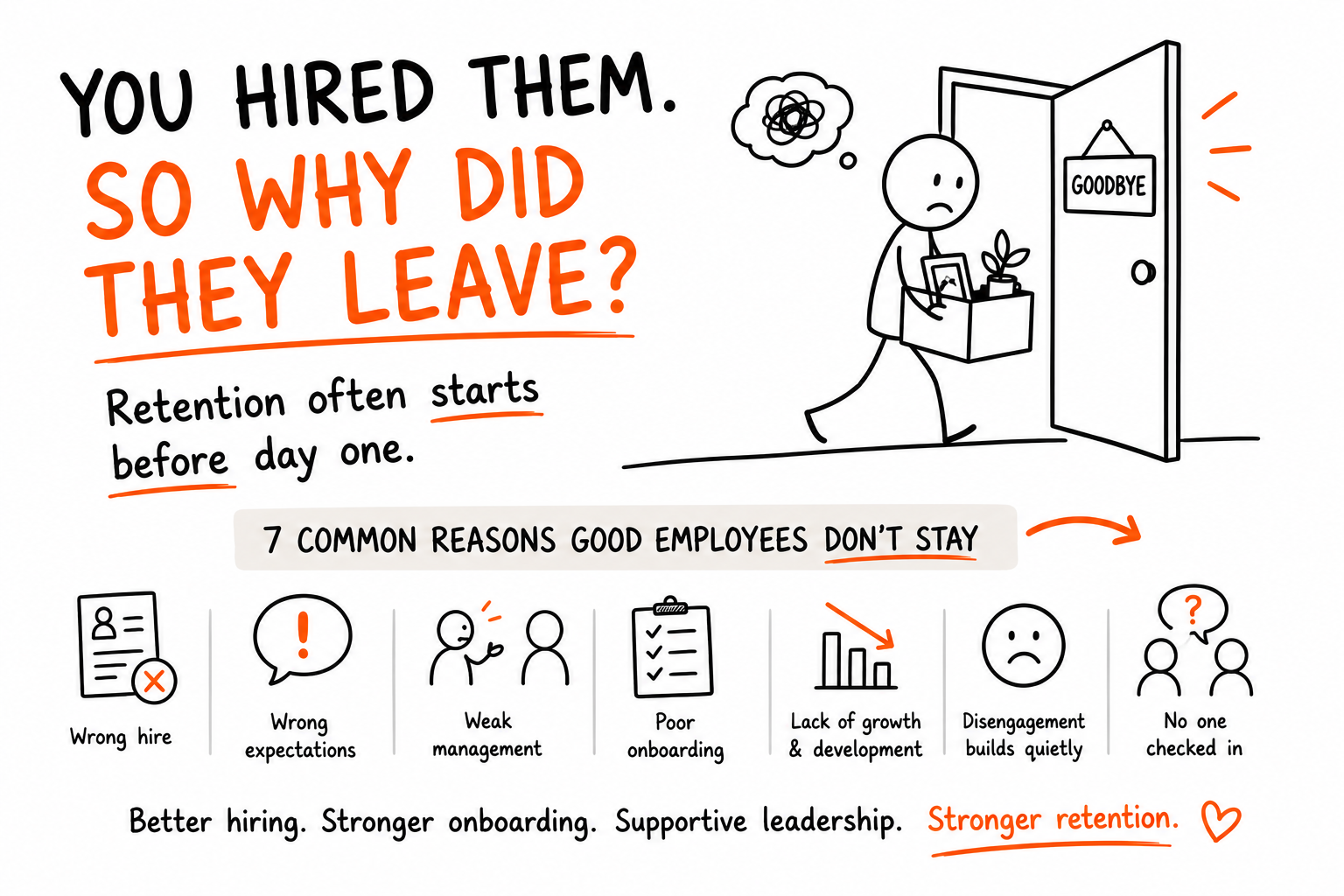
You Hired Them. So Why Can’t You Keep Them?
If good employees keep leaving, the problem may not be your hiring. It may be what happens after the offer is accepted.
There is a particularly frustrating kind of turnover.
You finally find someone who looks right. You interview them. Your team likes them. You make the offer. They accept. Everyone exhales.
Then, a few months later, you’re back where you started.
The job is open again. Your team is stretched thin. Your manager is frustrated. You’re spending time recruiting instead of running the business. And somewhere in the back of your mind is the question nobody really wants to ask:
“Did we hire the wrong person?”
Sometimes, yes.
But if this keeps happening, repeatedly blaming the hire can hide a much more expensive problem: your company may be hiring people into an employee experience they were never prepared to succeed in.

Research on retention points to a pattern that should make employers pause. Employees leave for many different reasons, but a meaningful share of turnover is connected to things employers can actually influence: management, workload, career growth, expectations, culture, and the day-to-day experience of doing the job.
Gallup’s research found that 42% of employees who voluntarily left said their manager or organization could have done something to prevent their departure. Work Institute’s 2025 Retention Report also found that career-related issues remained the largest category of employee turnover, accounting for 18.9% of turnover in 2024.
So before you launch another job posting, let’s look at what might actually be happening.
The Most Expensive Hiring Mistake Happens After the Hire
Most companies think of hiring as a funnel:
Job post → applicants → interviews → offer → hire.
But the employee sees a different journey:
Promise → expectation → reality → relationship → growth → decision to stay or leave.
That difference matters.
You may have successfully convinced someone to accept the job while accidentally creating expectations the actual job cannot meet.
Gallup research has repeatedly pointed to the importance of delivering on the promises made during recruitment. The job description, interview, employer brand, manager conversations and offer all create expectations about what working for your company will actually feel like.
If reality immediately contradicts those expectations, the employee doesn’t necessarily think, “This company has an onboarding problem.”
They think:
“I made a mistake.”
And once someone starts thinking that, retention gets a lot harder.
Reason #1: The Job You Sold Isn’t the Job They Got
This one is incredibly easy to miss because nobody necessarily lied.
The job description said one thing. The hiring manager described another. The interview focused on the exciting parts. Then the employee arrived and discovered the less glamorous reality.
- The “fast-paced environment” actually means constant understaffing.
- The “high level of autonomy” actually means nobody knows what success looks like.
- The “opportunity to wear many hats” actually means three people’s jobs were combined into one.
- The “growth opportunity” has no actual path attached to it.
- The “collaborative culture” depends entirely on which manager you report to.
Gallup’s research identifies unrealistic job expectations and responsibilities as one of the reasons employees leave. Gallup also notes that there can be a meaningful gap between the external job posting, the internal job description and what the employee is actually expected to do.
This is why a realistic job preview matters.
You don’t want to sell the job as perfect.
“I know what I’m signing up for, and I still want it.”
That is a much stronger foundation for retention than getting someone excited enough to accept an offer and hoping reality doesn’t scare them away.
If your company is struggling to attract the right people in the first place, start with your job description. A vague or inflated posting can create problems long before the first interview.
Reason #2: Nobody Told Them What “Good” Looks Like
Imagine starting a new job and spending your first month trying to decode what your manager actually wants.
You finish one task and wonder if it was done correctly.
You make a decision and wonder whether you overstepped.
You prioritize one project and wonder whether your manager secretly wanted the other one first.
Eventually, you stop feeling like a new employee who is learning and start feeling like an employee who is failing.
Gallup’s onboarding research has found that only a minority of employees strongly agree their organization does a great job onboarding new employees. Gallup also emphasizes that managers play a central role in clarifying expectations and helping new hires understand what success looks like.
Tell the new hire:
- What matters most in the first 30 days.
- What success looks like at 60 and 90 days.
- Which responsibilities belong to them.
- Which decisions they can make independently.
- What mistakes are normal while learning.
- How their performance will actually be evaluated.
Do not make someone spend six months discovering the rules of the game.
Reason #3: Your Onboarding Ends When the Paperwork Does
There is a difference between orientation and onboarding.
Orientation gets someone through the administrative basics. Onboarding helps someone become successful inside the organization.
That means the employee needs more than a laptop, login credentials and a stack of forms.
They need context. Relationships. Training. Feedback. Access to the people they depend on. A clear understanding of how the company works. And enough time to become competent without feeling abandoned.
SHRM recommends measuring onboarding using things such as time-to-productivity, retention rates, new-hire surveys, engagement and performance. Onboarding should not be treated as a box you check. It should be treated as part of the system that produces the employee outcome you want.
Gallup similarly describes onboarding as a longer employee journey rather than a single event.
If your new-hire process is basically:
“Welcome! Here’s your laptop. Here’s the handbook. Good luck.”
you have not really finished hiring.
Reason #4: Their Manager Is Making the Job Unlivable
This is the uncomfortable one.
You can have a great salary, good benefits and an impressive company mission. A bad manager can still make someone want to leave.
Gallup’s research found that 52% of exiting employees said their manager or organization could have done something to prevent them from leaving. In its updated 2026 analysis, Gallup reported that 42% of voluntary leavers said their departure could have been prevented.
The preventable factors were not limited to money. Gallup identified issues including manager relationships, organizational frustrations, career advancement, staffing and workload.
That means retention is not just an HR problem.
It is a management problem.
If your managers are unclear, unavailable, dismissive, overly controlling or constantly changing priorities, your retention strategy will struggle no matter how good your recruiting team is.
“If this employee resigned tomorrow, would I be genuinely surprised?”
If the answer is yes, ask why. If the answer is no, you have a warning signal.
For more on the hidden costs of turnover, see the $4,700 turnover crisis.
Reason #5: They Can’t See a Future There
“We want you to grow with us” sounds great.
But employees eventually ask:
Grow into what?
Work Institute’s 2025 Retention Report found that career-related issues remained the primary category of turnover for the 14th consecutive year, representing 18.9% of turnover in 2024.
That does not mean every employee needs a promotion every year. It means people need evidence that their career is moving somewhere.
- New responsibilities.
- Skill development.
- Mentorship.
- Clear promotion criteria.
- Internal mobility.
- Leadership opportunities.
- A conversation about where they want their career to go.
If the only career conversation happens during an annual review, you may be discovering the employee’s plans to leave after they have already made them.
Reason #6: The Workload Quietly Changed
This happens constantly in growing businesses.
Someone gets hired to solve a problem. Then the business grows. Another employee leaves. A new project lands. Someone says, “Can you just take this on for now?”
Three months later, the job has quietly become twice as large.
Gallup’s research on preventable turnover identifies staffing and workload concerns as meaningful contributors to employees’ decisions to leave.
When someone resigns, don’t only ask, “Why did they leave?” Ask whether the workload changed, the team shrank, responsibilities expanded without corresponding recognition, priorities constantly shifted, or resources became inadequate.
Sometimes turnover is not a motivation problem. Sometimes the job simply became unreasonable.
Reason #7: You’re Trying to Fix Retention With More Hiring
This is where the cycle becomes expensive.
An employee leaves. You post the job. Applicants come in. You interview. You hire. You onboard. The employee leaves. Repeat.
At some point, the answer cannot be “we need to recruit faster.” You may need to ask whether your hiring process is correctly identifying people who can actually succeed in the environment you’re putting them into.
That connects directly to why 46% of new hires fail.
A strong candidate can still be the wrong hire if the role, manager, expectations or environment are fundamentally misaligned. And a good hire can still leave if the organization fails to keep the promises that convinced them to join.
A Simple New-Hire Retention Audit
Before you spend another dollar trying to attract more applicants, take the last five employees who left and answer these questions.
- What did we tell them the job would be?
- What did the job actually become?
- Did they know what success looked like?
- How involved was their manager during the first 90 days?
- What training and support did they actually receive?
- Could they see a realistic path for growth?
- Did their workload stay reasonable?
- Did we have regular conversations about how things were going?
- What did they say in their exit interview?
- Have other employees complained about the same thing?
Then look for repetition.
If three people independently say the manager was unavailable, that is not three unrelated resignations.
If multiple employees say the job was different from what they expected, that is not bad luck.
If people repeatedly leave after six months because they cannot see a future there, that is not a recruiting problem.
It is a system problem.
Track Retention Like You Track Hiring
Most companies know their hiring metrics. They know time-to-fill. They know cost-per-hire. They know how many applicants they received.
But if you want to understand why employees are leaving, you need to follow the employee after the offer letter.
SHRM recommends tracking metrics such as time-to-productivity, turnover and retention rates, new-hire surveys, engagement, satisfaction and performance.
Ask:
- Which roles have the highest first-year turnover?
- Which managers have unusually high new-hire attrition?
- How long do employees stay after being hired?
- Where do new hires struggle to reach productivity?
- Are people leaving because of the job, the manager, the workload or the organization?
- Are the same reasons appearing in multiple exit interviews?
You can also compare retention data with recruiting data. If a particular source consistently produces employees who leave quickly, you may have a quality-of-hire problem rather than a volume problem.
Our guide to the five metrics that reveal a broken recruiting process is a useful place to start.
The Real Goal Isn’t “Hire Better People”
That phrase gets thrown around constantly. But it can quietly put all the responsibility on the candidate.
Sometimes you absolutely need to improve candidate quality. But retention asks a bigger question:
“Once we find the right person, have we built an environment where the right person can actually succeed?”
Because the best recruiter in the world cannot compensate for a manager who never checks in.
A perfect job description cannot compensate for a job that changes every three weeks.
A great salary cannot automatically compensate for a miserable employee experience.
And an excellent hire cannot stay forever in a role where they cannot see a future.
Before You Reopen the Job, Fix the Reason They Left
If someone leaves, the instinct is to replace them. That makes sense operationally.
But before you reopen the requisition, take a breath.
Ask what the vacancy is trying to teach you.
Because every resignation contains information.
The question is whether your company is actually collecting it.
Start with your last five departures. Find the pattern. Fix the pattern. Then hire for the environment you actually have, not the environment you wish you had.
That is how hiring and retention finally start working together instead of operating as two separate departments, each wondering why the other keeps creating problems.
Sources & Further Reading
- Gallup: 42% of Employee Turnover Is Preventable but Often Ignored
- Gallup: Employee Retention & Attraction
- Gallup: Essential Ingredients for an Effective Onboarding Program
- Gallup: Practical Tips for Leaders for a Better Onboarding Process
- Work Institute: 2025 Retention Report
- SHRM: How to Measure Onboarding Success
- SHRM: These Onboarding Gaps Hurt Retention More Than You Think
- U.S. Bureau of Labor Statistics: Job Openings and Labor Turnover Survey
- American Psychological Association: Workers’ New-Job Excitement Often Lasts Less Than a Year
Related HRmango Resources
- Why 46% of New Hires Fail
- The $4,700 Crisis: Why Employee Turnover Is Draining Your Business
- How to Keep Your Best Workers Happy
- The Impact of Company Culture on Hiring and Retention
- From Chaos to Clarity: How to Audit Your Hiring Process in 30 Days
- How to Reduce Recruiting Costs Without Sacrificing Quality
- Which Applicant Tracking System Makes Sense for Small Businesses?
- How to Use an ATS to Hire Your First 10 Employees
- You’re Getting Plenty of Applicants. So Why Are None of Them Qualified?
- Your Interviews Are Freaking People Out. Here’s the Fix.